
Bitmo Lab is testing an ultra-thin, bendable tracker built to fit inside items traditional trackers can’t
Updated
February 12, 2026 4:43 PM
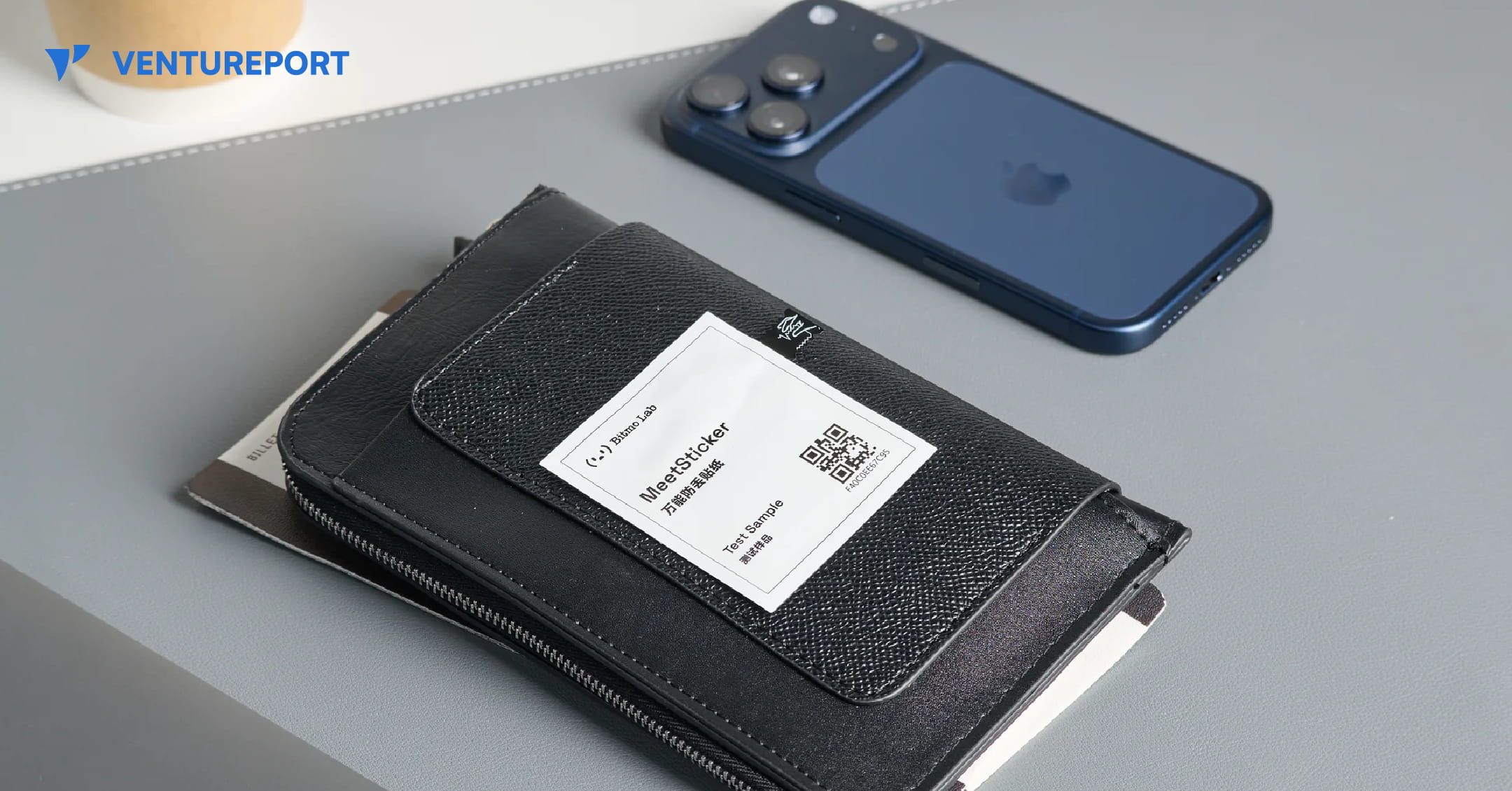
Bitmo Lab's MeetSticker tracker. PHOTO: BITMO LAB
Location trackers have become everyday accessories for keys, bags and luggage. But as personal items grow slimmer and more design-focused — from minimalist wallets to passport sleeves and specialised gear — tracking them has become less straightforward. Most trackers are built as small, rigid discs that assume the presence of space, loops or compartments. That assumption has created a growing mismatch between modern product design and the technology meant to secure it.
Hong Kong–based startup Bitmo Lab is attempting to address that gap with a device called MeetSticker. Instead of the solid plastic casing typical of most trackers, MeetSticker is engineered to be flexible and ultra-thin, measuring just 0.8 millimetres thick. The bendable design allows it to sit within narrow compartments or along curved surfaces without altering the shape of the object. Rather than attaching to an item externally, it is intended to integrate discreetly inside it.
That structural shift is the core of the product’s proposition. By removing the rigid shell that defines conventional tracking hardware, MeetSticker can be placed in items that previously had no practical way to accommodate a tracker. Bitmo Lab states that the device connects through a proprietary network and a companion application compatible with both iOS and Android, positioning it as a cross-platform solution rather than one tied to a single ecosystem.
The implications extend beyond form factor. Objects without obvious attachment points — such as compact travel accessories or specialised tools — could potentially be monitored without visible add-ons. In doing so, the device broadens the scope of tracking technology into categories where aesthetics, aerodynamics or compact design matter as much as functionality.
Before moving toward retail distribution, however, the company is focusing on validation. Bitmo Lab has launched a five-week global alpha testing programme beginning February 9. Sixty participants will receive a prototype unit and early access to the app. According to the company, the programme is designed to assess durability, usability and real-world performance before a wider commercial release. Participants who provide feedback will receive a retail unit upon launch.
Such testing is particularly relevant for flexible electronics. Unlike rigid devices, bendable hardware must withstand repeated flexing, daily handling and environmental exposure. Early user data can help refine manufacturing processes and software optimisation before scaling production.
As with other connected tracking devices, privacy considerations remain part of the equation. Bitmo Lab has stated that data collected during the alpha programme will be used strictly for testing purposes and deleted once the programme concludes.
Whether flexible trackers will redefine the category will depend on how they perform outside controlled testing environments. Still, the introduction of a near-invisible, bendable tracking device reflects a broader shift in consumer technology. As everyday products become thinner and more design-conscious, the tools built to protect them may need to adapt just as seamlessly.
Keep Reading
HKU professor apologizes after PhD student’s AI-assisted paper cites fabricated sources.
Updated
January 8, 2026 6:33 PM
.jpg)
The University of Hong Kong in Pok Fu Lam, Hong Kong Island. PHOTO: ADOBE STOCK
It’s no surprise that artificial intelligence, while remarkably capable, can also go astray—spinning convincing but entirely fabricated narratives. From politics to academia, AI’s “hallucinations” have repeatedly shown how powerful technology can go off-script when left unchecked.
Take Grok-2, for instance. In July 2024, the chatbot misled users about ballot deadlines in several U.S. states, just days after President Joe Biden dropped his re-election bid against former President Donald Trump. A year earlier, a U.S. lawyer found himself in court for relying on ChatGPT to draft a legal brief—only to discover that the AI tool had invented entire cases, citations and judicial opinions. And now, the academic world has its own cautionary tale.
Recently, a journal paper from the Department of Social Work and Social Administration at the University of Hong Kong was found to contain fabricated citations—sources apparently created by AI. The paper, titled “Forty Years of Fertility Transition in Hong Kong,” analyzed the decline in Hong Kong’s fertility rate over the past four decades. Authored by doctoral student Yiming Bai, along with Yip Siu-fai, Vice Dean of the Faculty of Social Sciences and other university officials, the study identified falling marriage rates as a key driver behind the city’s shrinking birth rate. The authors recommended structural reforms to make Hong Kong’s social and work environment more family-friendly.
But the credibility of the paper came into question when inconsistencies surfaced among its references. Out of 61 cited works, some included DOI (Digital Object Identifier) links that led to dead ends, displaying “DOI Not Found.” Others claimed to originate from academic journals, yet searches yielded no such publications.
Speaking to HK01, Yip acknowledged that his student had used AI tools to organize the citations but failed to verify the accuracy of the generated references. “As the corresponding author, I bear responsibility”, Yip said, apologizing for the damage caused to the University of Hong Kong and the journal’s reputation. He clarified that the paper itself had undergone two rounds of verification and that its content was not fabricated—only the citations had been mishandled.
Yip has since contacted the journal’s editor, who accepted his explanation and agreed to re-upload a corrected version in the coming days. A formal notice addressing the issue will also be released. Yip said he would personally review each citation “piece by piece” to ensure no errors remain.
As for the student involved, Yip described her as a diligent and high-performing researcher who made an honest mistake in her first attempt at using AI for academic assistance. Rather than penalize her, Yip chose a more constructive approach, urging her to take a course on how to use AI tools responsibly in academic research.
Ultimately, in an age where generative AI can produce everything from essays to legal arguments, there are two lessons to take away from this episode. First, AI is a powerful assistant, but only that. The final judgment must always rest with us. No matter how seamless the output seems, cross-checking and verifying information remain essential. Second, as AI becomes integral to academic and professional life, institutions must equip students and employees with the skills to use it responsibly. Training and mentorship are no longer optional; they’re the foundation for using AI to enhance, not undermine, human work.
Because in this age of intelligent machines, staying relevant isn’t about replacing human judgment with AI, it’s about learning how to work alongside it.