
A new safety layer aims to help robots sense people in real time without slowing production
Updated
February 13, 2026 10:44 AM
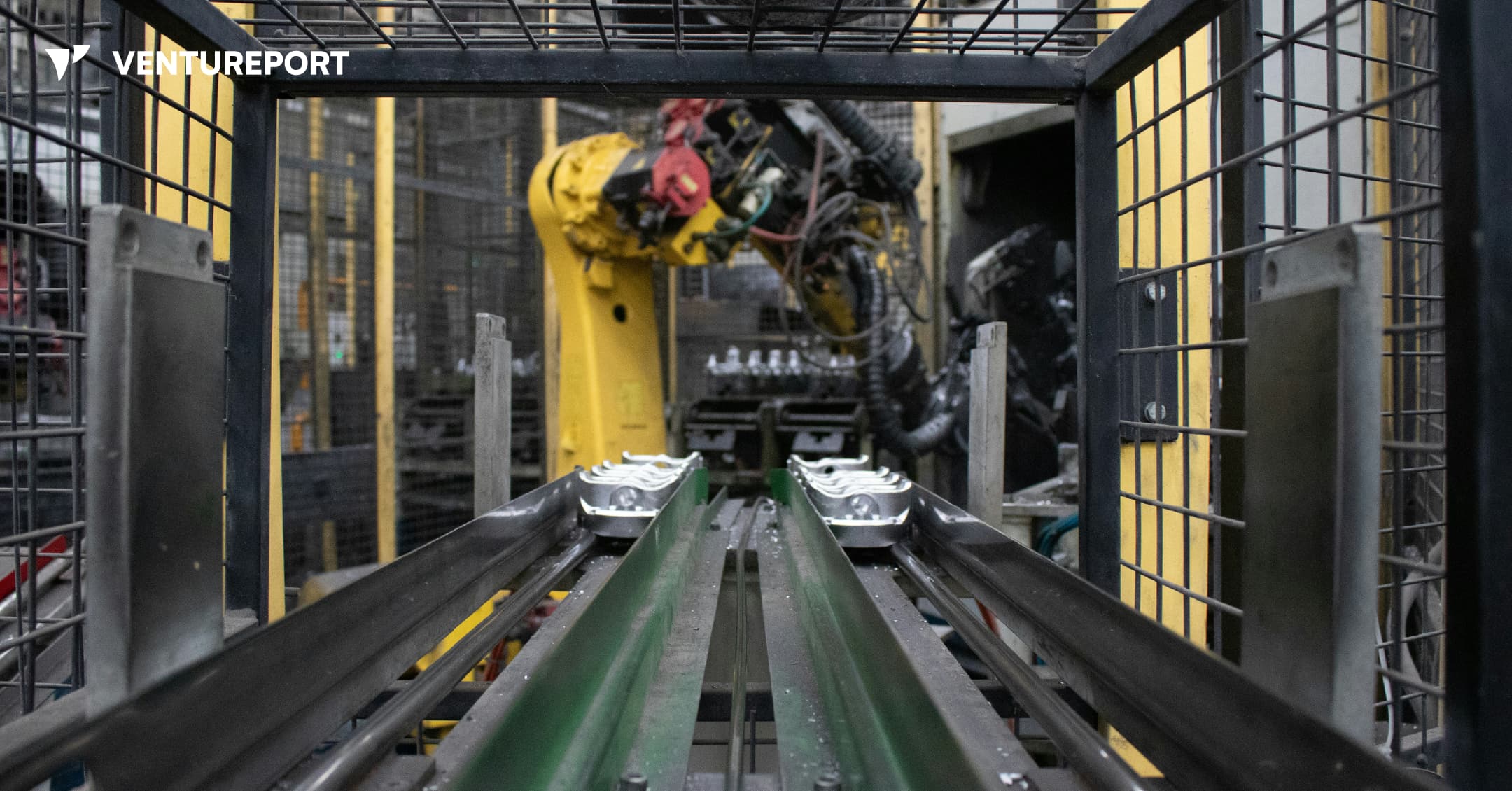
An industrial robot in a factory. PHOTO: UNSPLASH
Algorized has raised US$13 million in a Series A round to advance its AI-powered safety and sensing technology for factories and warehouses. The California- and Switzerland-based robotics startup says the funding will help expand a system designed to transform how robots interact with people. The round was led by Run Ventures, with participation from the Amazon Industrial Innovation Fund and Acrobator Ventures, alongside continued backing from existing investors.
At its core, Algorized is building what it calls an intelligence layer for “physical AI” — industrial robots and autonomous machines that function in real-world settings such as factories and warehouses. While generative AI has transformed software and digital workflows, bringing AI into physical environments presents a different challenge. In these settings, machines must not only complete tasks efficiently but also move safely around human workers.
This is where a clear gap exists. Today, most industrial robots rely on camera-based monitoring systems or predefined safety zones. For instance, when a worker steps into a marked area near a robotic arm, the system is programmed to slow down or stop the machine completely. This approach reduces the risk of accidents. However, it also means production lines can pause frequently, even when there is no immediate danger. In high-speed manufacturing environments, those repeated slowdowns can add up to significant productivity losses.
Algorized’s technology is designed to reduce that trade-off between safety and efficiency. Instead of relying solely on cameras, the company utilizes wireless signals — including Ultra-Wideband (UWB), mmWave, and Wi-Fi — to detect movement and human presence. By analysing small changes in these radio signals, the system can detect motion and breathing patterns in a space. This helps machines determine where people are and how they are moving, even in conditions where cameras may struggle, such as poor lighting, dust or visual obstruction.
Importantly, this data is processed locally at the facility itself — not sent to a remote cloud server for analysis. In practical terms, this means decisions are made on-site, within milliseconds. Reducing this delay, or latency, allows robots to adjust their movements immediately instead of defaulting to a full stop. The aim is to create machines that can respond smoothly and continuously, rather than reacting in a binary stop-or-go manner.
With the new funding, Algorized plans to scale commercial deployments of its platform, known as the Predictive Safety Engine. The company will also invest in refining its intent-recognition models, which are designed to anticipate how humans are likely to move within a workspace. In parallel, it intends to expand its engineering and support teams across Europe and the United States. These efforts build on earlier public demonstrations and ongoing collaborations with manufacturing partners, particularly in the automotive and industrial sectors.
For investors, the appeal goes beyond safety compliance. As factories become more automated, even small improvements in uptime and workflow continuity can translate into meaningful financial gains. Because Algorized’s system works with existing wireless infrastructure, manufacturers may be able to upgrade machine awareness without overhauling their entire hardware setup.
More broadly, the company is addressing a structural limitation in industrial automation. Robotics has advanced rapidly in precision and power, yet human-robot collaboration is still governed by rigid safety systems that prioritise stopping over adapting. By combining wireless sensing with edge-based AI models, Algorized is attempting to give machines a more continuous awareness of their surroundings from the start.
Keep Reading
Can innovation truly deliver affordable housing to those who need it most?
Updated
January 8, 2026 6:35 PM

Close up of a 3D printer nozzle pouring concrete. PHOTO: ICON
The affordable housing crisis has become one of the most pressing challenges of our time. Across the globe, millions of people are struggling to secure a roof over their heads. In cities like San Francisco, housing prices are so high that even middle-income families find themselves shut out of the market.
The root of this crisis lies in a persistent imbalance: the supply of housing has failed to keep pace with growing demand. Factors such as high construction costs, bureaucratic hurdles, and limited available land in urban areas have made it increasingly difficult to build enough homes quickly and affordably. The result is a market where housing remains inaccessible to millions, even as the need becomes more urgent.
Technology is now stepping in to address these challenges in ways that were unimaginable just a decade ago. From streamlining construction processes to introducing new financing models and data-driven tools, tech innovations are rethinking how homes are built, financed, and accessed. But while these advancements offer hope, they also raise important questions: can they truly address the root causes of the housing crisis, or are they simply patching up a fractured system?
The housing crisis begins with supply shortage: we simply aren’t building enough homes. Traditional construction methods are expensive, slow, and reliant on labor that is increasingly hard to find. This is where technology is making its most significant impact. Startups likeICON and Veev are leading the charge, using cutting-edge solutions to make housing more efficient and affordable.
ICON, for instance, uses 3D printing to build homes faster and at a lower cost. By printing the structure of a house directly on-site, ICON reduces waste, labor requirements, and construction time. Entire neighborhoods of 3D-printed homes are already being built, showcasing how this technology can scale.
Veev, on the other hand, focuses on prefabricated construction. By manufacturing high-quality components like walls and steel frames in a controlled factory environment, Veev eliminates inefficiencies associated with on-site building. These components are then assembled on location, drastically reducing construction time and costs. This approach mirrors the principles of mass production seen in industries like automotive manufacturing, where efficiency and scalability are key.
While building more homes is essential, access to housing often depend son financing. For many people, especially those with low or irregular incomes, the traditional mortgage system presents insurmountable barriers. Fintech innovations are stepping in to make housing financing more inclusive and flexible.
Access to affordable housing often hinges on financing, and innovative financial technology (fintech) solutions are beginning to change the landscape. Some platforms are offering new ways for individuals to transition from renting to owning, while others are introducing shared equity models that reduce the traditional barriers of large down payments and strict credit requirements. For example, companies like Point use shared-equity financing, where homeowners receive funds in exchange for a percentage of their home’s future value instead of taking on traditional debt. Meanwhile, startups are building tools that automate and simplify and revolutionizing the mortgage process, making it easier for underserved populations to access loans tailored to their needs.
Blockchain technology is also changing the game. By digitizing land titles and creating secure records of financial transactions, blockchain reduces the complexity and difficulty of accessing credit, especially for those with limited traditional credit. This is particularly impactful in regions where informal economies dominate and traditional proof of income is scarce. These tools create a pathway to homeownership for individuals who would otherwise be excluded from the system.
Beyond building and financing, technology is transforming how we understand and address housing needs. Artificial intelligence (AI) is revolutionizing risk assessment in the mortgage industry by analyzing a broader range of financial behaviors, such as rent and utility payments, to provide a more inclusive picture of creditworthiness.
At the same time, AI and big data are helping policymakers and developers make smarter decisions about where and how to build. By analyzing population trends, commuting patterns, and infrastructure needs, these tools ensure that new housing developments are built in the right places, reducing wasteful construction and improving urban planning.
For example, startups are using 3D scanning and machine learning to map informal settlements and identify buildings at risk of collapse. These insights not only improve safety but also guide investment toward areas where housing is most desperately needed.
The housing crisis is one of the most complex challenges of our time, and technology alone cannot solve it. But it can provide powerful tools to address specific pain points, from streamlining construction to expanding access to financing. Startups like ICON, Veev, and Landis are proving that innovation can lower costs, improve efficiency, and make housing more inclusive.
However, the ultimate solution lies in a combination of technology, policy reform, and community engagement. Governments must work alongside tech innovators to create urban environments that prioritize affordability, sustainability, and accessibility.
The future of housing isn’t just about building more homes; it’s about building smarter, greener, and fairer cities where everyone has a place to call home. By integrating cutting-edge technologies with forward-thinking policies, we can move closer to a world where affordable housing is not an aspiration but a reality.
The question is no longer whether technology can solve the housing crisis—it’s how we will use it wisely to create lasting change.