
Rethinking 3D modelling for a world that generates too much, too quickly.
Updated
January 8, 2026 6:32 PM
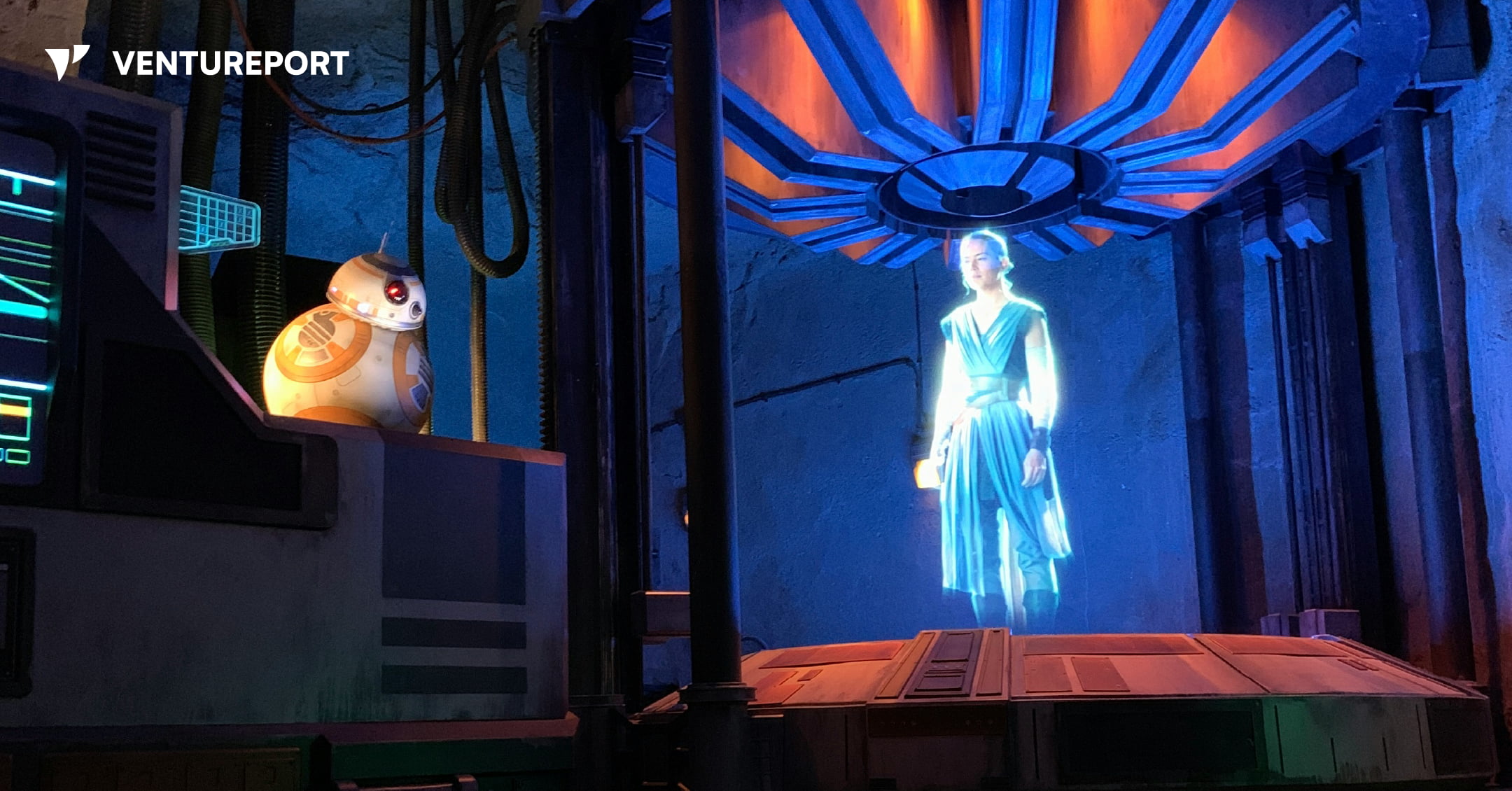
A hologram in the franchise Star Wars, in Walt Disney World Resort, Orlando. PHOTO: UNSPLASH
MicroCloud Hologram Inc. (NASDAQ: HOLO), a technology service provider recognized for its holography and imaging systems, is now expanding into a more advanced realm: a quantum-driven 3D intelligent model. The goal is to generate detailed 3D models and images with far less manual effort — a need that has only grown as industries flood the world with more visual data every year.
The concept is straightforward, even if the technology behind it isn’t. Traditional 3D modeling workflows are slow, fragmented and depend on large teams to clean datasets, train models, adjust parameters and fine-tune every output. HOLO is trying to close that gap by combining quantum computing with AI-powered 3D modeling, enabling the system to process massive datasets quickly and automatically produce high-precision 3D assets with much less human involvement.
To achieve this, the company developed a distributed architecture comprising of several specialized subsystems. One subsystem collects and cleans raw visual data from different sources. Another uses quantum deep learning to understand patterns in that data. A third converts the trained model into ready-to-use 3D assets based on user inputs. Additional modules manage visualization, secure data storage and system-wide protection — all supported by quantum-level encryption. Each subsystem runs in its own container and communicates through encrypted interfaces, allowing flexible upgrades and scaling without disrupting the entire system.
Why this matters: Industries ranging from gaming and film to manufacturing, simulation and digital twins are rapidly increasing their reliance on 3D content. The real bottleneck isn’t creativity — it’s time. Producing accurate, high-quality 3D assets still requires a huge amount of manual processing. HOLO’s approach attempts to lighten that workload by utilizing quantum tools to speed up data processing, model training, generation and scaling, while keeping user data secure.
According to the company, the system’s biggest advantages include its ability to handle massive datasets more efficiently, generate precise 3D models with fewer manual steps, and scale easily thanks to its modular, quantum-optimized design. Whether quantum computing will become a mainstream part of 3D production remains an open question. Still, the model shows how companies are beginning to rethink traditional 3D workflows as demand for high-quality digital content continues to surge.
Keep Reading
A closer look at the tech, AI, and open ecosystem behind Tien Kung 3.0’s real-world push
Updated
February 18, 2026 8:03 PM

Humanoid robots working in a warehouse. PHOTO: ADOBE STOCK
Humanoid robotics has advanced quickly in recent years. Machines can now walk, balance, and interact with their surroundings in ways that once seemed out of reach. Yet most deployments remain limited. Many robots perform well in controlled settings but struggle in real-world environments. Integration is often complex, hardware interfaces are closed, software tools are fragmented, and scaling across industries remains difficult.
Against this backdrop, X-Humanoid has introduced its latest general-purpose platform, Embodied Tien Kung 3.0. The company positions it not simply as another humanoid robot, but as a system designed to address the practical barriers that have slowed adoption, with a focus on openness and usability.
At the hardware level, Embodied Tien Kung 3.0 is built for mobility, strength, and stability. It is equipped with high-torque integrated joints that provide strong limb force for high-load applications. The company says it is the first full-size humanoid robot to achieve whole-body, high-dynamic motion control integrated with tactile interaction. In practice, this means the robot is designed to maintain balance and execute dynamic movements even in uneven or cluttered environments. It can clear one-meter obstacles, perform consecutive high-dynamic maneuvers, and carry out actions such as kneeling, bending, and turning with coordinated whole-body control.
Precision is also a focus. Through multi-degree-of-freedom limb coordination and calibrated joint linkage, the system is designed to achieve millimeter-level operational accuracy. This level of control is intended to support industrial-grade tasks that require consistent performance and minimal error across changing conditions.
But hardware is only part of the equation. The company pairs the robot with its proprietary Wise KaiWu general-purpose embodied AI platform. This system supports perception, reasoning, and real-time control through what the company describes as a coordinated “brain–cerebellum” architecture. It establishes a continuous perception–decision–execution loop, allowing the robot to operate with greater autonomy and reduced reliance on remote control.
For higher-level cognition, Wise KaiWu incorporates components such as a world model and vision-language models (VLM) to interpret visual scenes, understand language instructions, and break complex objectives into structured steps. For real-time execution, a vision-language-action (VLA) model and full autonomous navigation system manage obstacle avoidance and precise motion under variable conditions. The platform also supports multi-agent collaboration, enabling cross-platform compatibility, asynchronous task coordination, and centralized scheduling across multiple robots.
A central part of the platform is openness. The company states that the system is designed to address compatibility and adaptation challenges across both development and deployment layers. On the hardware side, Embodied Tien Kung 3.0 includes multiple expansion interfaces that support different end-effectors and tools, allowing faster adaptation to industrial manufacturing, specialized operations, and commercial service scenarios. On the software side, the Wise KaiWu ecosystem provides documentation, toolchains, and a low-code development environment. It supports widely adopted communication standards, including ROS2, MQTT, and TCP/IP, enabling partners to customize applications without rebuilding core systems.
The company also highlights its open-source approach. X-Humanoid has open-sourced key components from the Embodied Tien Kung and Wise KaiWu platforms, including the robot body architecture, motion control framework, world model, embodied VLM and cross-ontology VLA models, training toolchains, the RoboMIND dataset, and the ArtVIP simulation asset library. By opening access to these elements, the company aims to reduce development costs, lower technical barriers, and encourage broader participation from researchers, universities, and enterprises.
Embodied Tien Kung 3.0 enters a market where technical progress is visible but large-scale adoption remains uneven. The gap is not only about movement or strength. It is about integration, interoperability, and the ability to operate reliably and autonomously in everyday industrial and commercial settings. If platforms can reduce fragmentation and simplify deployment, humanoid robots may move beyond demonstrations and into sustained commercial use.
In that sense, the significance of Embodied Tien Kung 3.0 lies less in isolated technical claims and more in how its high-dynamic hardware, embodied AI system, open interfaces, and collaborative architecture are structured to work together. Whether that integrated approach can close the deployment gap will shape how quickly humanoid robotics becomes part of real-world operations.