
Grab your popcorn—2026 is going to be a huge year for sci-fi fans. Big stories are hitting the big screen, from survival epics on a ruined Earth to time-bending adventures and eerie tales of AI love gone wrong. Some are fresh takes, others are long-awaited sequels, but all promise to keep you talking long after the credits roll. Here are five sci-fi movies you’ll want to mark on your calendar.

Release Date: January 9, 2026
Director: Kate Dolan
Stars: Lily Sullivan, David Rysdahl and Claudia Doumit
Soulm8te will take you to a dark AI universe. The film follows a grieving man who turns to an AI android to ease the pain of losing his wife. At first, the relationship feels like a second chance at love, but the bond soon spirals into a dangerous romance.
Noting how companion-style robots already exist in parts of the world, Wan and executive producer Allison Williams wanted to reimagine technology in the form of a female humanoid built for intimacy. Wan, who also directed M3GAN 2.0, another chilling story centered on an AI doll, brings that same unsettling vision to Soulm8te. Ultimately, what begins as comfort soon twists into obsession, turning desire into a deadly consequence.
.jpg)
Release Date: January 9, 2026
Director: Ric Roman Waugh,
Stars: Morena Baccarin, Amber Rose Revah, Sophie Thompson, Trond Fausa Aurvåg
Back in 2020, Greenland introduced audiences to John Garrity (Gerard Butler), a father racing against time to save his family as fragments of a comet threatened to wipe out life on Earth. The story ended with humanity’s last hope lying in survival bunkers deep in Greenland.
The sequel, Greenland: Migration, picks up several years later as the Garrity family emerges from shelter into a devastated world. Now set in post-apocalyptic Europe, John must lead his family across a dangerous wasteland in search of a new home. With survival once again at stake, the journey promises both peril and resilience.

Release Date: March 20, 2026
Director: Phil Lord & Chris Miller
Stars: Ryan Gosling, Milana Vayntrub, Sandra Hüller
Andy Weir’s sci-fi novel Project Hail Mary (from the author of The Martian) is headed to the big screen, with Ryan Gosling starring as Ryland Grace. Once a junior high science teacher, Grace wakes up inside a spaceship with no memory of who he is or why he’s there. He’s been in a coma for nearly four years, kept alive by advanced robotic arms that fed and rotated his body. Slowly, he recalls the truth: this is a suicide mission, with no fuel or food to bring him back home.
Turns out, his path to space began when Eva Stratt, head of a global task force, recruited him after reading his paper on alien survival without water. Now Grace must stop a deadly infestation of star-eating microbes called “astrophage” before they wipe out life on Earth.
Keep Reading
Rethinking 3D modelling for a world that generates too much, too quickly.
Updated
December 5, 2025 3:46 PM
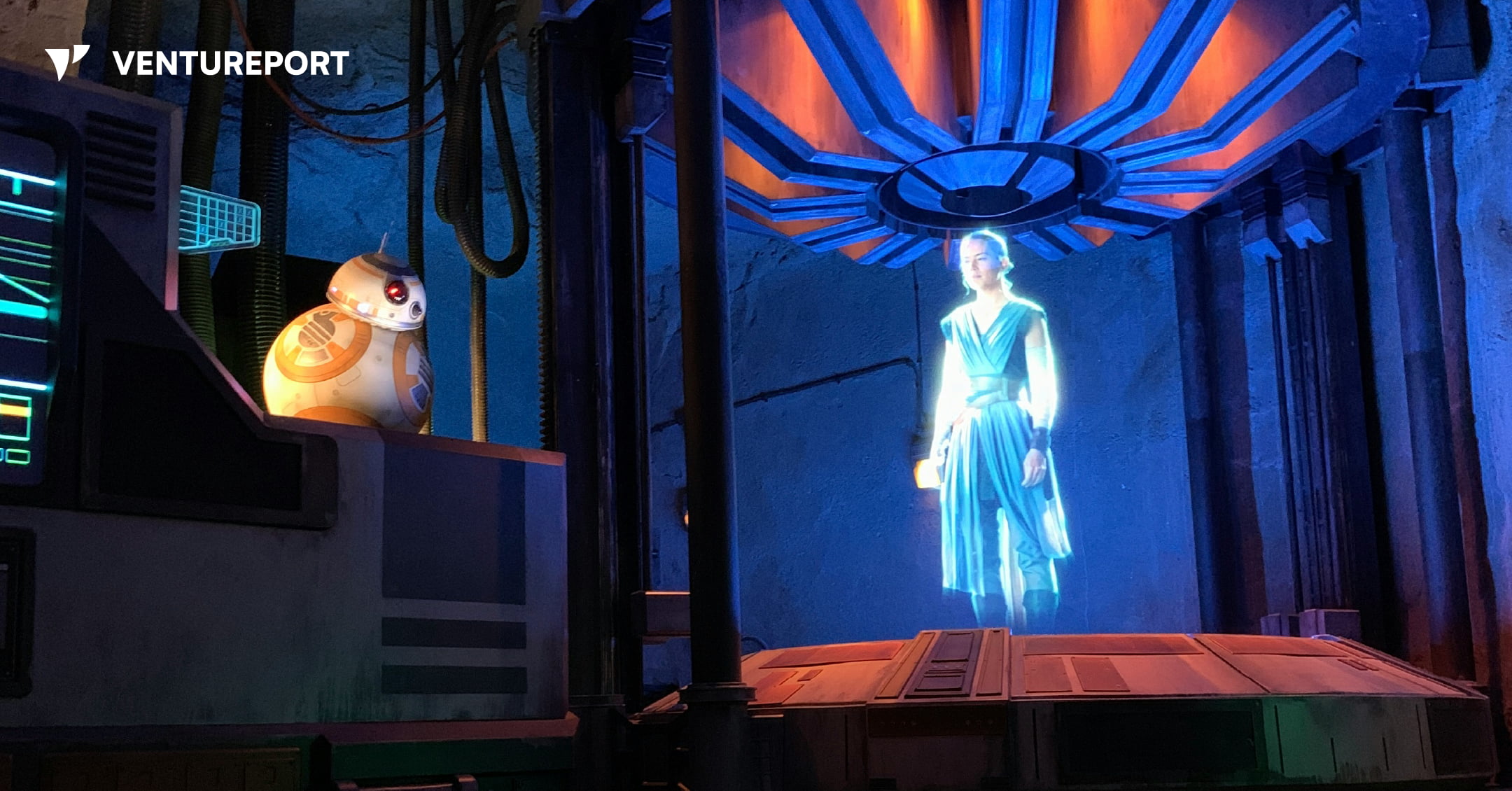
A hologram in the franchise Star Wars, in Walt Disney World Resort, Orlando. PHOTO: UNSPLASH
MicroCloud Hologram Inc. (NASDAQ: HOLO), a technology service provider recognized for its holography and imaging systems, is now expanding into a more advanced realm: a quantum-driven 3D intelligent model. The goal is to generate detailed 3D models and images with far less manual effort — a need that has only grown as industries flood the world with more visual data every year.
The concept is straightforward, even if the technology behind it isn’t. Traditional 3D modeling workflows are slow, fragmented and depend on large teams to clean datasets, train models, adjust parameters and fine-tune every output. HOLO is trying to close that gap by combining quantum computing with AI-powered 3D modeling, enabling the system to process massive datasets quickly and automatically produce high-precision 3D assets with much less human involvement.
To achieve this, the company developed a distributed architecture comprising of several specialized subsystems. One subsystem collects and cleans raw visual data from different sources. Another uses quantum deep learning to understand patterns in that data. A third converts the trained model into ready-to-use 3D assets based on user inputs. Additional modules manage visualization, secure data storage and system-wide protection — all supported by quantum-level encryption. Each subsystem runs in its own container and communicates through encrypted interfaces, allowing flexible upgrades and scaling without disrupting the entire system.
Why this matters: Industries ranging from gaming and film to manufacturing, simulation and digital twins are rapidly increasing their reliance on 3D content. The real bottleneck isn’t creativity — it’s time. Producing accurate, high-quality 3D assets still requires a huge amount of manual processing. HOLO’s approach attempts to lighten that workload by utilizing quantum tools to speed up data processing, model training, generation and scaling, while keeping user data secure.
According to the company, the system’s biggest advantages include its ability to handle massive datasets more efficiently, generate precise 3D models with fewer manual steps, and scale easily thanks to its modular, quantum-optimized design. Whether quantum computing will become a mainstream part of 3D production remains an open question. Still, the model shows how companies are beginning to rethink traditional 3D workflows as demand for high-quality digital content continues to surge.