
Getting to the Moon was the first chapter. Interlune and Astrolab are working on how to operate there.
Updated
March 6, 2026 1:32 AM

Apollo 17 Astronaut's Snapshot of Taurus-Littrow Valley. PHOTO: UNSPLASH
As plans for a long-term human presence on the Moon pick up pace, the focus is shifting from landing there to working there. It is one thing to reach the surface. It is another to build roads, prepare sites and extract materials in a way that can support real activity.
That is where Interlune and Astrolab come in. Interlune is a space resources company. Astrolab builds planetary rovers. The two are now working together to mount Interlune’s lunar digging system onto Astrolab’s Flexible Logistics and Exploration (FLEX) rover. They have completed a concept study and are planning hardware testing in Houston.
The aim is straightforward: combine a rover that can move reliably across the Moon with equipment that can dig, collect and handle lunar soil. Interlune is focused on harvesting natural resources from the Moon, starting with helium-3. To do that at scale, the system cannot sit in one place. It has to move across the surface, handle dust and operate in harsh conditions. "Reliable, autonomous mobility is crucial to the Interlune harvesting system and broader lunar infrastructure development", said Rob Meyerson, co-founder and CEO of Interlune. "Astrolab's FLEX is the right vehicle for the job".
By fitting its digging and collection hardware onto FLEX, Interlune is working toward a mobile system that can gather large amounts of lunar soil and support future construction needs. Beyond helium-3, the same setup could help prepare base sites, level ground, build protective barriers and lay the groundwork for other structures. In simple terms, it is about turning a rover into a working machine for the Moon.
The partnership also connects to Interlune’s work with Vermeer Corporation to develop equipment for continuous, high-volume digging adapted to lunar conditions. Taken together, the goal is to build systems that can support both commercial and government missions — whether that means resource extraction or preparing land for future bases.
For Astrolab, the collaboration strengthens the role of FLEX as more than just a transport vehicle.
"Working with Interlune further differentiates FLEX as the rover of choice for commercial and government Moon missions", said Jaret Matthews, Astrolab founder and CEO. "Interlune's expertise in developing and testing highly specialized regolith simulant will further enhance FLEX's ability to mitigate dust and operate in extreme environments".
Testing will be centered in Houston, which is becoming an important hub for commercial space development. Astrolab was the first company to lease space at the Texas A&M University Space Institute, currently under construction at NASA’s Johnson Space Center. Interlune operates the Houston-based Interlune Research Lab, where it creates and tests simulated versions of lunar soil.
That detail matters. Moon dust is fine, abrasive and difficult to manage. Before any hardware flies, it needs to prove it can survive and function in those conditions. By testing their systems in realistic soil simulants, the companies can refine how the rover moves and how the digging system performs.
The Houston lab is partially funded by the Texas Space Commission, reflecting the growing role of regional space initiatives in supporting private companies building beyond Earth. Overall, the collaboration is not about grand promises. It is about integrating hardware, running real tests and taking practical steps toward operating on the Moon.
Keep Reading
Rethinking 3D modelling for a world that generates too much, too quickly.
Updated
January 8, 2026 6:32 PM
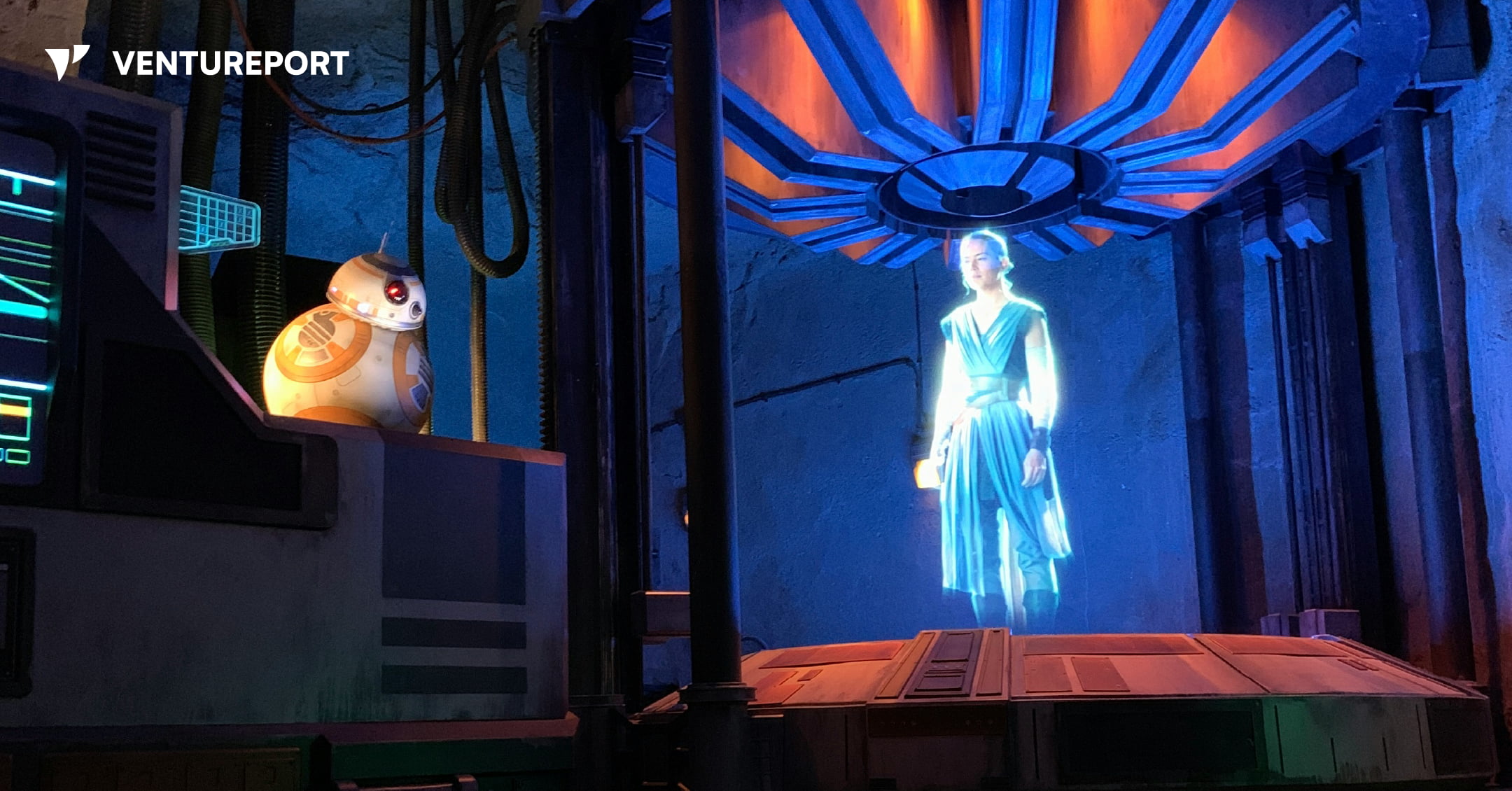
A hologram in the franchise Star Wars, in Walt Disney World Resort, Orlando. PHOTO: UNSPLASH
MicroCloud Hologram Inc. (NASDAQ: HOLO), a technology service provider recognized for its holography and imaging systems, is now expanding into a more advanced realm: a quantum-driven 3D intelligent model. The goal is to generate detailed 3D models and images with far less manual effort — a need that has only grown as industries flood the world with more visual data every year.
The concept is straightforward, even if the technology behind it isn’t. Traditional 3D modeling workflows are slow, fragmented and depend on large teams to clean datasets, train models, adjust parameters and fine-tune every output. HOLO is trying to close that gap by combining quantum computing with AI-powered 3D modeling, enabling the system to process massive datasets quickly and automatically produce high-precision 3D assets with much less human involvement.
To achieve this, the company developed a distributed architecture comprising of several specialized subsystems. One subsystem collects and cleans raw visual data from different sources. Another uses quantum deep learning to understand patterns in that data. A third converts the trained model into ready-to-use 3D assets based on user inputs. Additional modules manage visualization, secure data storage and system-wide protection — all supported by quantum-level encryption. Each subsystem runs in its own container and communicates through encrypted interfaces, allowing flexible upgrades and scaling without disrupting the entire system.
Why this matters: Industries ranging from gaming and film to manufacturing, simulation and digital twins are rapidly increasing their reliance on 3D content. The real bottleneck isn’t creativity — it’s time. Producing accurate, high-quality 3D assets still requires a huge amount of manual processing. HOLO’s approach attempts to lighten that workload by utilizing quantum tools to speed up data processing, model training, generation and scaling, while keeping user data secure.
According to the company, the system’s biggest advantages include its ability to handle massive datasets more efficiently, generate precise 3D models with fewer manual steps, and scale easily thanks to its modular, quantum-optimized design. Whether quantum computing will become a mainstream part of 3D production remains an open question. Still, the model shows how companies are beginning to rethink traditional 3D workflows as demand for high-quality digital content continues to surge.