
HyveGeo’s approach to restoring degraded land stands out at the FoodTech Challenge
Updated
February 7, 2026 2:18 PM

Clusters of sandstone buttes in Monument Valley, Colorado Plateau. PHOTO: UNSPLASH
HyveGeo, a climate-focused startup, has been named one of the global winners of the FoodTech Challenge, an international competition designed to surface practical technologies that strengthen food systems in arid and climate-stressed regions.
The FoodTech Challenge (FTC) is based in the UAE and brings together governments, foundations and agri-food institutions to identify early-stage solutions that address food production, land degradation and resource efficiency. Each year, hundreds of startups apply from around the world. In 2026, more than 1,200 teams from 113 countries submitted entries. Only four were selected.
HyveGeo stood out for its approach to one of agriculture’s hardest problems: how to make desert soil usable again. Founded in 2023 by a group of scientists and researchers, the Abu Dhabi-based company focuses on regenerating degraded land using a process built around biochar, a carbon-rich material made from agricultural waste, enhanced with microalgae. The aim is to accelerate soil recovery in environments where water is limited and land has been heavily stressed.
What caught the judges’ attention was not just the technology itself, but the way it links several challenges at once. The system turns waste into a usable soil input, reduces the time it takes for land to become productive and locks carbon into the ground instead of releasing it into the atmosphere. In short, it addresses land degradation, food production and climate pressure through a single framework.
As a winner of the FoodTech Challenge, HyveGeo will share a US$2 million prize with the other selected startups. Beyond funding, the company will also receive support from the UAE’s innovation ecosystem, including research backing, pilot projects, market access and incubation services to help move from testing into wider deployment.
The team’s plans focus on scaling within the UAE first. HyveGeo aims to work across Abu Dhabi’s network of farms and gradually expand into other arid and climate-stressed regions. Its longer-term target is to restore thousands of hectares of degraded land and contribute to carbon removal through soil-based methods.
Placed in a broader context, HyveGeo’s win reflects a shift in how food and climate technologies are being evaluated. Instead of chasing dramatic breakthroughs, competitions like the FTC are increasingly backing systems that connect waste, land, water and carbon into something usable on the ground. Not futuristic agriculture, but practical repair work for environments that can no longer rely on old farming assumptions. If that direction continues, the next wave of food innovation may be less about spectacle and more about quiet, scalable fixes for places where growing food has become hardest.
Keep Reading
How a Korean biotech startup is using AI to move drug discovery from trial-and-error to precision design
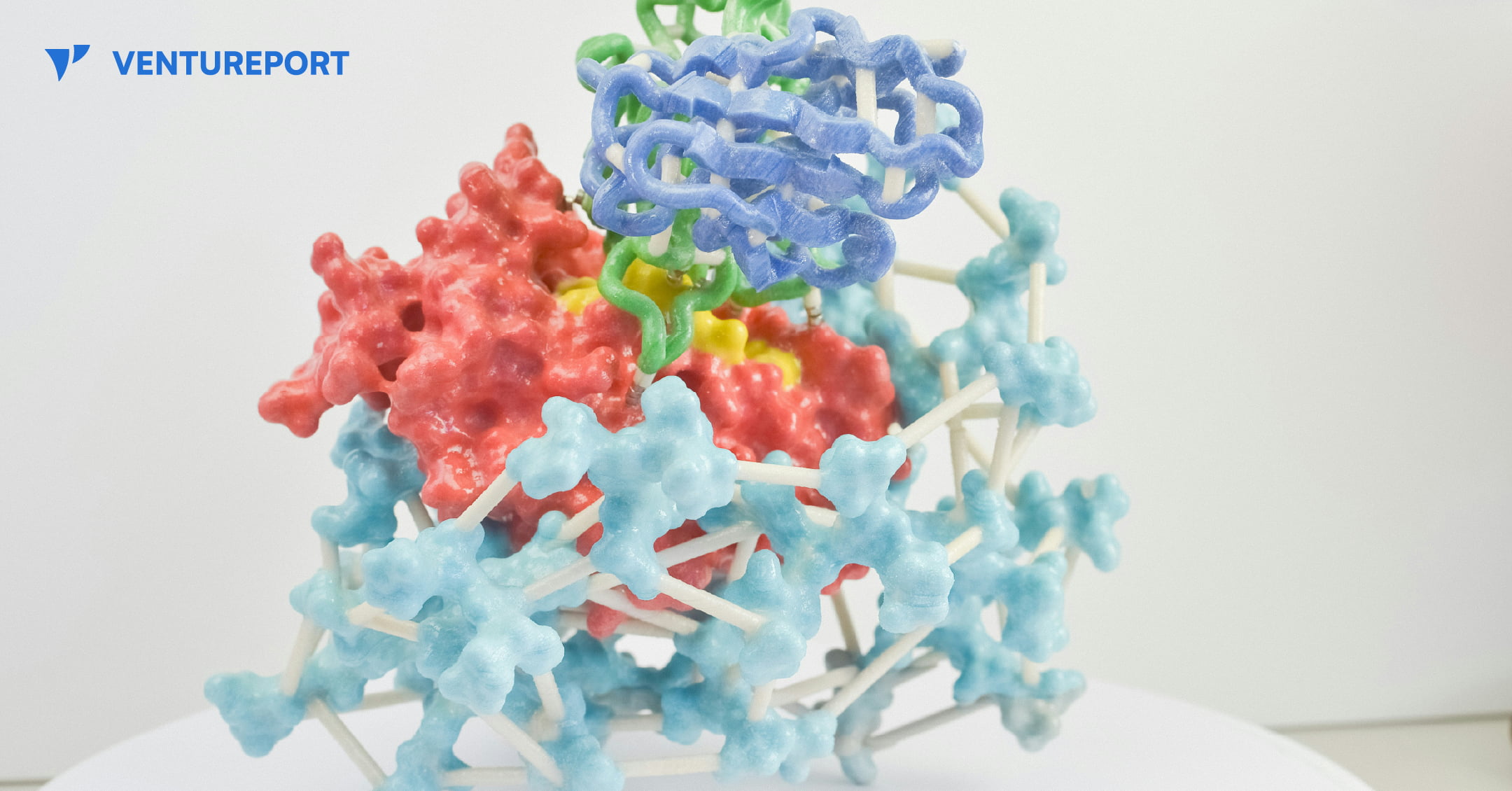
A close up of a protein structure model. PHOTO: UNSPLASH
For decades, drug discovery has relied on trial and error, with scientists testing thousands of molecules to find one that works. Galux, a South Korean biotech startup, is changing that by using AI to design proteins from scratch. This method, called “de novo” design, makes it possible to build precise new therapies instead of searching through existing ones.
The company recently announced a US$29 million Series B funding round, bringing its total capital to US$47 million.This significant investment attracted a substantial roster of institutional backers, including the Korea Development Bank (KDB), Yuanta Investment, SL Investment and NCORE Ventures. These firms joined existing investors such as InterVest, DAYLI Partners and PATHWAY Investment, as well as new participants including SneakPeek Investments, Korea Investment & Securities and Mirae Asset Securities.
At the core of the company’s work is a platform called GaluxDesign. Unlike many AI tools that only predict how existing proteins fold, this system uses deep learning and physics to create entirely new therapeutic antibodies. This “from scratch” approach lets the team go after so-called “undruggable” proteins. These are targets that traditional small-molecule drugs can’t reach because they lack clear binding pockets. By designing proteins to fit these complex shapes, Galux aims to unlock treatments that have stayed out of reach for decades. And that’s exactly why investors are paying attention.
The pharmaceutical industry is actively looking for faster and more efficient ways to develop new drugs, and Galux is built for exactly that. The company connects its AI platform directly to its own wet lab, where designs can be tested in real time. Each result feeds straight back into the system, sharpening the next round of models. This continuous loop speeds up discovery and improves precision at every step. It’s also why partners like Celltrion, LG Chem and Boehringer Ingelheim are already working with Galux.
Galux is no longer just trying to make drugs that stick to a target. The company now wants its AI to design medicines that actually work in the body and can be made at scale. In simple terms, a drug has to do more than bind to a disease—it must be stable, safe and strong enough to change how the illness behaves. Galux is moving into tougher targets such as ion channels and GPCRs. These play key roles in heart function and sensory signals. Ultimately, the goal is to show that AI-driven design can turn complex biology into real treatments. And instead of hunting blindly for a solution, the team is building exactly what they need.