
A Massachusetts startup advances scalable light-control tech for AR, AI and imaging markets
Updated
February 27, 2026 3:59 PM

Myrias Optics' Nanoimprinted All-inorganic Metaoptic. PHOTO: MYRIAS OPTICS
Myrias Optics, a Massachusetts-based optical technology startup, has raised US$2.1 million in a Seed 1 financing round to accelerate the commercialization of its advanced light-control technology. The round was led by MassVentures, with participation from existing investors Hoss Investment Inc., Maroon Venture Partners and Tenon Venture Partners, as well as new investors Mill Town Capital, TiE Boston Angels and Doug Crane. This new round follows a US$3.3 million seed financing completed in December 2023, led by Asia Optical, and a US$1.5 million Direct-to-Phase II award from the National Science Foundation. In total, Myrias has secured US$6.9 million to date, positioning it to move from development to scaled production.
The company builds ultra-thin, nano-patterned surfaces that precisely control how light moves through a device. These structures replace or enhance traditional lenses and optical parts inside products such as augmented reality headsets, AI data center hardware, consumer electronics, industrial systems and medical imaging devices. The goal is straightforward: to deliver high optical performance while making the parts easier and more cost-effective to manufacture in large quantities.
Across industries such as augmented reality and AI infrastructure, manufacturers face a common challenge. They need highly precise light-guiding components that can withstand heat and long-term use. At the same time, those components must be produced consistently and at scale. Traditional semiconductor-style fabrication can be costly, while polymer-based optical manufacturing can face limits in durability and thermal stability.
Myrias addresses this gap by using inorganic materials and a nanoimprint manufacturing process to create stable, repeatable optical layers on wafers. This approach is designed to combine performance with manufacturability. In augmented reality systems, for example, the company’s technology enables higher viewing angles while remaining suitable for volume production. In AI data centers, the same material and process advantages support improved light transfer and stronger performance under demanding thermal conditions. These benefits also extend to advanced imaging systems in consumer, industrial and medical markets.
The new Seed 1 funding is intended to expand manufacturing capacity and scale pilot production lines. The company will also continue executing active customer programs. Myrias is already working with strategic partners and Tier 1 supply chain participants to integrate its waveguide and light-shaping solutions into commercial AR platforms, AI photonics systems and advanced imaging products. The capital, therefore, supports a clear next step: moving from validated prototypes to a steady commercial supply.
Keep Reading
Rethinking 3D modelling for a world that generates too much, too quickly.
Updated
January 8, 2026 6:32 PM
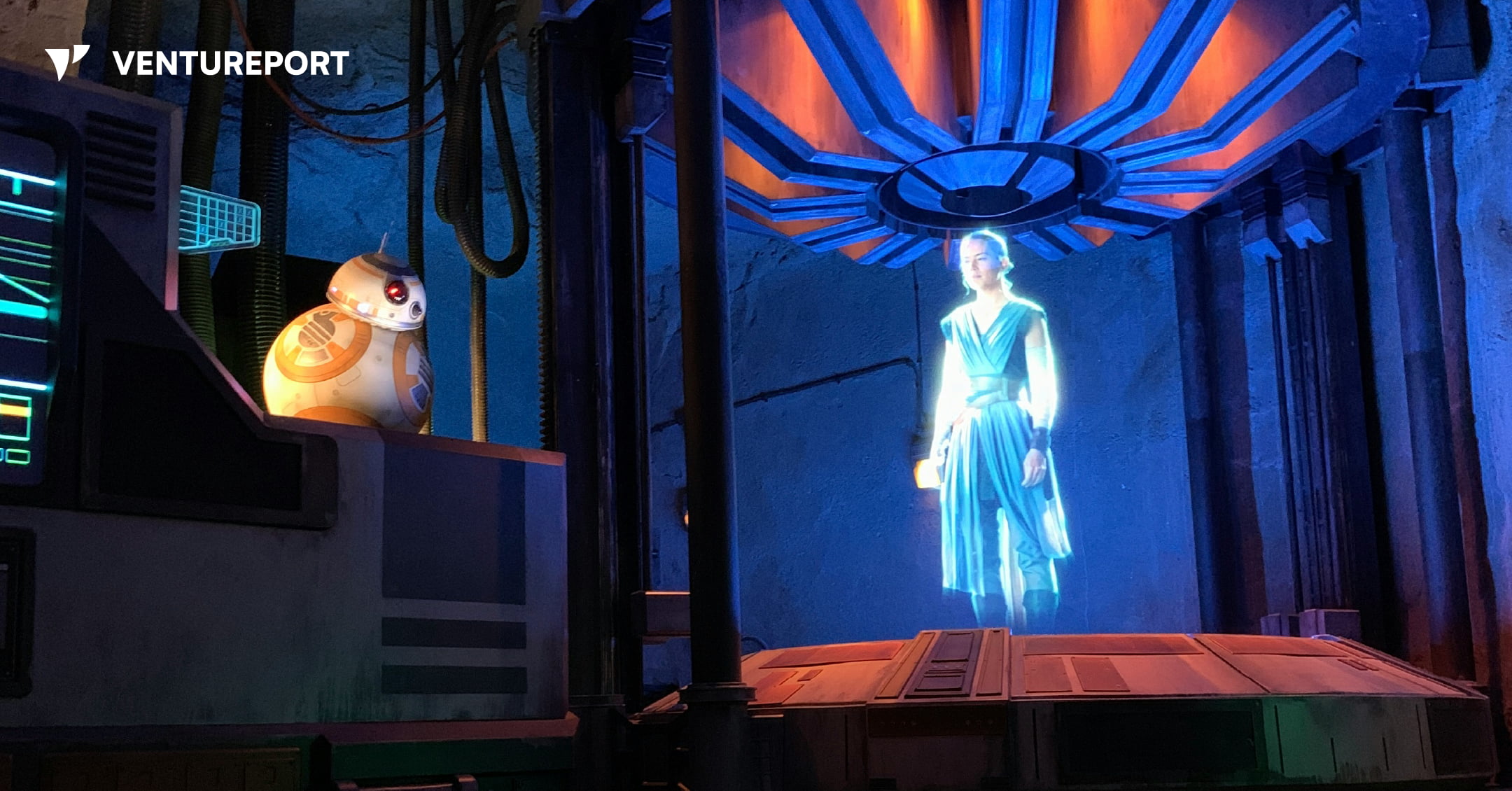
A hologram in the franchise Star Wars, in Walt Disney World Resort, Orlando. PHOTO: UNSPLASH
MicroCloud Hologram Inc. (NASDAQ: HOLO), a technology service provider recognized for its holography and imaging systems, is now expanding into a more advanced realm: a quantum-driven 3D intelligent model. The goal is to generate detailed 3D models and images with far less manual effort — a need that has only grown as industries flood the world with more visual data every year.
The concept is straightforward, even if the technology behind it isn’t. Traditional 3D modeling workflows are slow, fragmented and depend on large teams to clean datasets, train models, adjust parameters and fine-tune every output. HOLO is trying to close that gap by combining quantum computing with AI-powered 3D modeling, enabling the system to process massive datasets quickly and automatically produce high-precision 3D assets with much less human involvement.
To achieve this, the company developed a distributed architecture comprising of several specialized subsystems. One subsystem collects and cleans raw visual data from different sources. Another uses quantum deep learning to understand patterns in that data. A third converts the trained model into ready-to-use 3D assets based on user inputs. Additional modules manage visualization, secure data storage and system-wide protection — all supported by quantum-level encryption. Each subsystem runs in its own container and communicates through encrypted interfaces, allowing flexible upgrades and scaling without disrupting the entire system.
Why this matters: Industries ranging from gaming and film to manufacturing, simulation and digital twins are rapidly increasing their reliance on 3D content. The real bottleneck isn’t creativity — it’s time. Producing accurate, high-quality 3D assets still requires a huge amount of manual processing. HOLO’s approach attempts to lighten that workload by utilizing quantum tools to speed up data processing, model training, generation and scaling, while keeping user data secure.
According to the company, the system’s biggest advantages include its ability to handle massive datasets more efficiently, generate precise 3D models with fewer manual steps, and scale easily thanks to its modular, quantum-optimized design. Whether quantum computing will become a mainstream part of 3D production remains an open question. Still, the model shows how companies are beginning to rethink traditional 3D workflows as demand for high-quality digital content continues to surge.