
A Massachusetts startup advances scalable light-control tech for AR, AI and imaging markets
Updated
February 27, 2026 3:59 PM

Myrias Optics' Nanoimprinted All-inorganic Metaoptic. PHOTO: MYRIAS OPTICS
Myrias Optics, a Massachusetts-based optical technology startup, has raised US$2.1 million in a Seed 1 financing round to accelerate the commercialization of its advanced light-control technology. The round was led by MassVentures, with participation from existing investors Hoss Investment Inc., Maroon Venture Partners and Tenon Venture Partners, as well as new investors Mill Town Capital, TiE Boston Angels and Doug Crane. This new round follows a US$3.3 million seed financing completed in December 2023, led by Asia Optical, and a US$1.5 million Direct-to-Phase II award from the National Science Foundation. In total, Myrias has secured US$6.9 million to date, positioning it to move from development to scaled production.
The company builds ultra-thin, nano-patterned surfaces that precisely control how light moves through a device. These structures replace or enhance traditional lenses and optical parts inside products such as augmented reality headsets, AI data center hardware, consumer electronics, industrial systems and medical imaging devices. The goal is straightforward: to deliver high optical performance while making the parts easier and more cost-effective to manufacture in large quantities.
Across industries such as augmented reality and AI infrastructure, manufacturers face a common challenge. They need highly precise light-guiding components that can withstand heat and long-term use. At the same time, those components must be produced consistently and at scale. Traditional semiconductor-style fabrication can be costly, while polymer-based optical manufacturing can face limits in durability and thermal stability.
Myrias addresses this gap by using inorganic materials and a nanoimprint manufacturing process to create stable, repeatable optical layers on wafers. This approach is designed to combine performance with manufacturability. In augmented reality systems, for example, the company’s technology enables higher viewing angles while remaining suitable for volume production. In AI data centers, the same material and process advantages support improved light transfer and stronger performance under demanding thermal conditions. These benefits also extend to advanced imaging systems in consumer, industrial and medical markets.
The new Seed 1 funding is intended to expand manufacturing capacity and scale pilot production lines. The company will also continue executing active customer programs. Myrias is already working with strategic partners and Tier 1 supply chain participants to integrate its waveguide and light-shaping solutions into commercial AR platforms, AI photonics systems and advanced imaging products. The capital, therefore, supports a clear next step: moving from validated prototypes to a steady commercial supply.
Keep Reading
The collaboration between Oversonic Robotics and STMicroelectronics highlights how robotics is beginning to fill gaps traditional automation cannot.
Updated
January 23, 2026 10:41 AM
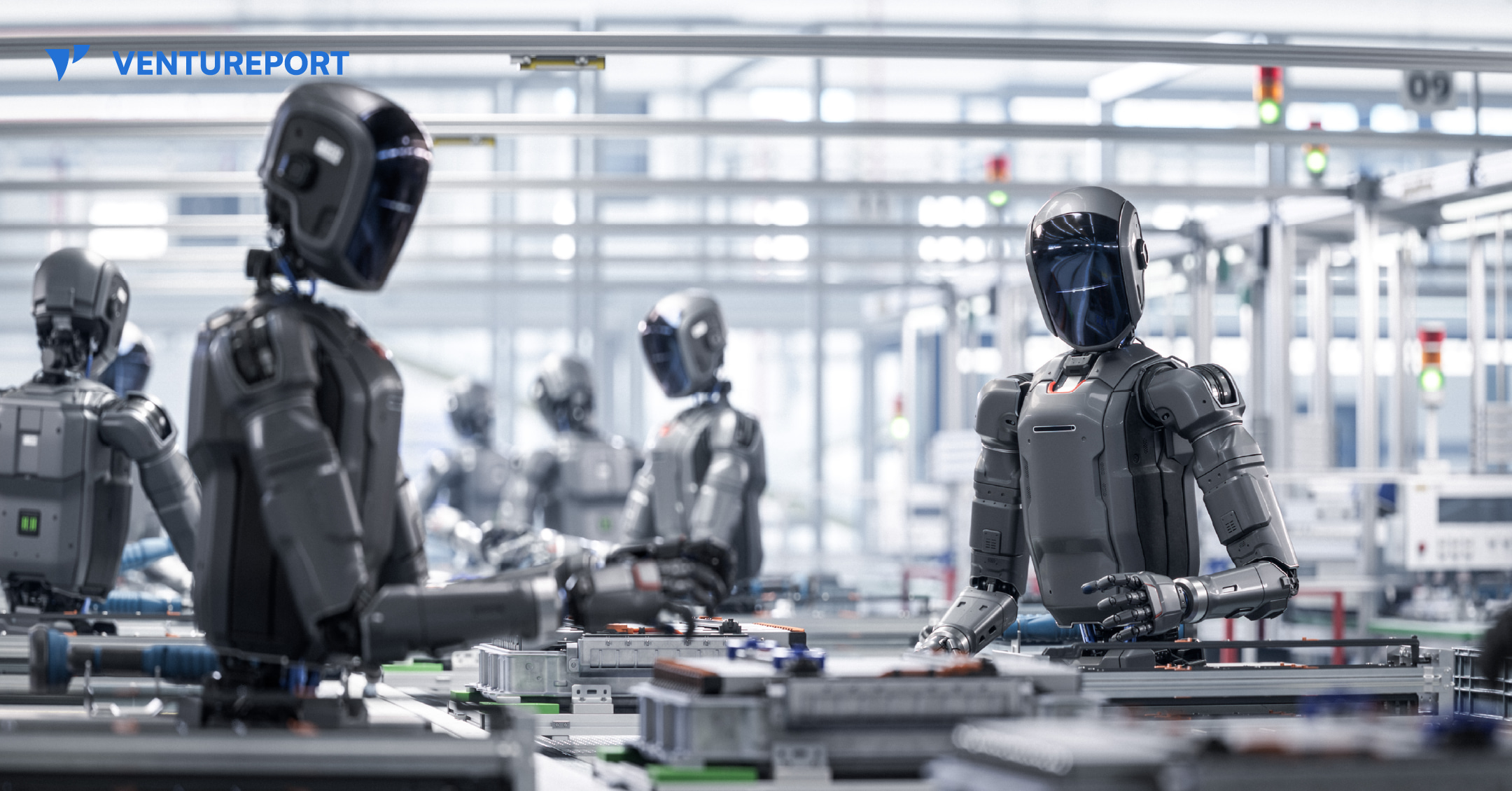
3D render of humanoid robots working in a factory assembly line. PHOTO: ADOBE STOCK
Oversonic Robotics, an Italian company known for building cognitive humanoid robots, has signed an agreement with STMicroelectronics, one of the world’s largest semiconductor manufacturers, to deploy humanoid robots inside semiconductor plants.
According to the companies, this is the first time cognitive humanoid robots will be used operationally inside semiconductor manufacturing facilities. And the first deployment has already taken place at ST’s advanced packaging and test plant in Malta.
At the center of the collaboration is RoBee, Oversonic’s humanoid robot. RoBee is designed to carry out support tasks within industrial environments, particularly where flexibility and interaction with human workers are required. In ST’s factories, the robots will assist with complex manufacturing and logistics flows linked to new semiconductor products. They are intended to work alongside existing automation systems, not replace them.
RoBee is notable for its ability to operate in environments shared with people. It is currently the only humanoid robot certified for use in both industrial and healthcare settings and is already in operation within several Italian companies. The robot is also being used in experimental hospital programs. That background helped position RoBee for deployment in tightly controlled manufacturing environments such as semiconductor plants.
Fabio Puglia, President of Oversonic Robotics, described the agreement as a milestone for deploying humanoid robots in complex industrial settings: “The partnership with STMicroelectronics is a great source of pride for us because it embodies the vision of cognitive robotics that Oversonic has brought to the industrial and healthcare markets. Being the first to introduce cognitive humanoid robots in a sophisticated production context such as semiconductors means measuring ourselves against the highest standards in terms of reliability, safety and operational continuity. This agreement represents a fundamental milestone for Oversonic and, more generally, for the industrial challenges these new machines are called to face in innovative and highly complex environments, alongside people and supporting their quality of work”.
From STMicroelectronics’ side, the use of humanoid robots is framed as part of a broader effort to manage growing manufacturing complexity. he company said RoBee will support complex tasks and help manage the intricate production flows required by newer semiconductor products. It is also expected to contribute to improved product quality and shorter manufacturing cycle times. The robots are designed to integrate with existing automation and software systems, helping improve safety and operational continuity.
In semiconductor manufacturing, precision and reliability leave little room for experimentation. Therefore, introducing humanoid robots into this environment signals a practical shift. It shows how robotics is starting to fill gaps that traditional automation has struggled to address.