
A humanoid robot being escorted away by police in Macau has gone viral online, prompting jokes about what some called the world’s first “robot arrest.”
Updated
March 17, 2026 12:53 AM
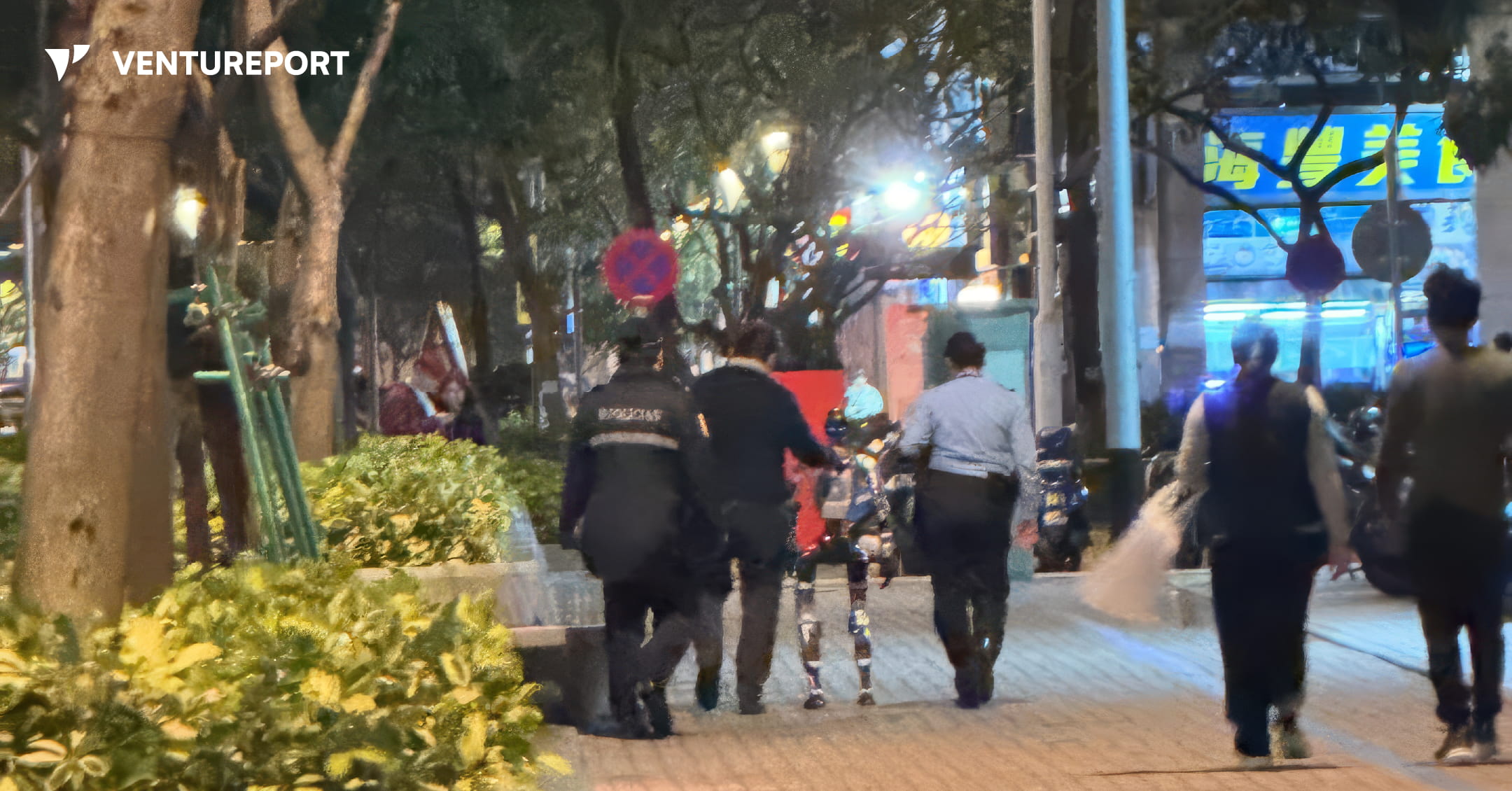
Macau police officer accompanying the humanoid robot. PHOTO: THREADS@BOXOF_CHOCOLATE
Police in Macau recently detained a humanoid robot after it frightened an elderly woman on a public street. The unusual encounter quickly spread online, prompting jokes about what some called the world’s first “robot arrest”.
On the evening of March 5, the robot was taken away by officers after the encounter triggered alarm among bystanders. Videos circulating on social media show an elderly woman confronting the robot on a sidewalk, visibly distressed and shouting that her “heart is pounding” while demanding to know why such “nonsense” was happening on the street. In the clip, the robot raises both hands toward the woman after she lashes out in fear — a gesture many viewers interpreted as a sign of apology.
Shortly afterwards, two officers from the Macau Public Security Police Force were seen escorting the robot and a man believed to be its operator away from the area. An officer is seen placing his right hand on the robot’s shoulder — the same posture police often use when presenting arrested suspects in official photographs.
That scene quickly spread online, fuelling jokes about what some called the world’s first “robot arrest”.
Photos shared online show a humanoid robot with long limbs and exposed mechanical joints, built from a black metallic frame without an outer shell. In dim lighting, several commenters said it resembled a “moving skeleton” — a striking sight for pedestrians encountering it unexpectedly on the street.
Witnesses said the woman appeared severely shaken and an ambulance was eventually called to take her to the hospital.
The incident also sparked discussion online about robots operating in public spaces. Some commenters argued that experimental technologies should be tested in controlled environments, while others said machines moving through public areas should have clearer designs or safety measures to avoid alarming pedestrians.
It remains unclear who deployed the robot or what purpose it was serving in the area at the time of the incident. Authorities have not released further details about the device or whether any action was taken following the encounter.
Keep Reading
From information gaps to global access — how AI is reshaping the pursuit of knowledge.
Updated
January 8, 2026 6:33 PM
.jpg)
Paper cut-outs of robots sitting on a pile of books. PHOTO: FREEPIK
Encyclopaedias have always been mirrors of their time — from heavy leather-bound volumes in the 19th century to Wikipedia’s community-edited pages online. But as the world’s information multiplies faster than humans can catalogue it, even open platforms struggle to keep pace. Enter Botipedia, a new project from INSEAD, The Business School for the World, that reimagines how knowledge can be created, verified and shared using artificial intelligence.
At its core, Botipedia is powered by proprietary AI that automates the process of writing encyclopaedia entries. Instead of relying on volunteers or editors, it uses a system called Dynamic Multi-method Generation (DMG) — a method that combines hundreds of algorithms and curated datasets to produce high-quality, verifiable content. This AI doesn’t just summarise what already exists; it synthesises information from archives, satellite feeds and data libraries to generate original text grounded in facts.
What makes this innovation significant is the gap it fills in global access to knowledge. While Wikipedia hosts roughly 64 million English-language entries, languages like Swahili have fewer than 40,000 articles — leaving most of the world’s population outside the circle of easily available online information. Botipedia aims to close that gap by generating over 400 billion entries across 100 languages, ensuring that no subject, event or region is overlooked.
"We are creating Botipedia to provide everyone with equal access to information, with no language left behind", says Phil Parker, INSEAD Chaired Professor of Management Science, creator of Botipedia and holder of one of the pioneering patents in the field of generative AI. "We focus on content grounded in data and sources with full provenance, allowing the user to see as many perspectives as possible, as opposed to one potentially biased source".
Unlike many generative AI tools that depend on large language models (LLMs), Botipedia adapts its methods based on the type of content. For instance, weather data is generated using geo-spatial techniques to cover every possible coordinate on Earth. This targeted, multi-method approach helps boost both the accuracy and reliability of what it produces — key challenges in today’s AI-driven content landscape.
Additionally, the innovation is also energy-efficient. Its DMG system operates at a fraction of the processing power required by GPU-heavy models like ChatGPT, making it a sustainable alternative for large-scale content generation.
By combining AI precision, linguistic inclusivity and academic credibility, Botipedia positions itself as more than a digital library — it’s a step toward universal, unbiased access to verified knowledge.
"Botipedia is one of many initiatives of the Human and Machine Intelligence Institute (HUMII) that we are establishing at INSEAD", says Lily Fang, Dean of Research and Innovation at INSEAD. "It is a practical application that builds on INSEAD-linked IP to help people make better decisions with knowledge powered by technology. We want technologies that enhance the quality and meaning of our work and life, to retain human agency and value in the age of intelligence".
By harnessing AI to bridge gaps of language, geography and credibility, Botipedia points to a future where access to knowledge is no longer a privilege, but a shared global resource.