
A humanoid robot being escorted away by police in Macau has gone viral online, prompting jokes about what some called the world’s first “robot arrest.”
Updated
March 17, 2026 12:53 AM
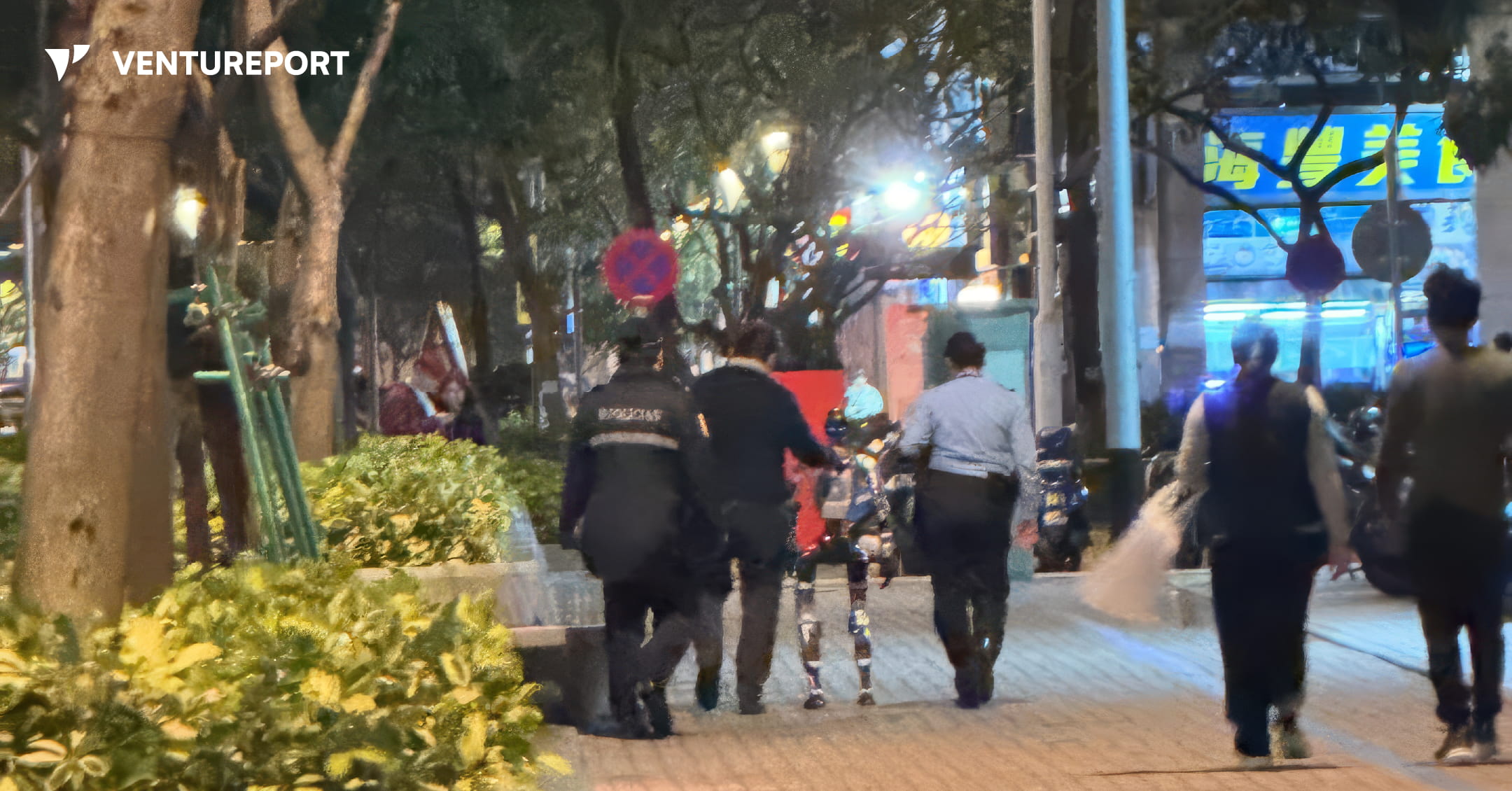
Macau police officer accompanying the humanoid robot. PHOTO: THREADS@BOXOF_CHOCOLATE
Police in Macau recently detained a humanoid robot after it frightened an elderly woman on a public street. The unusual encounter quickly spread online, prompting jokes about what some called the world’s first “robot arrest”.
On the evening of March 5, the robot was taken away by officers after the encounter triggered alarm among bystanders. Videos circulating on social media show an elderly woman confronting the robot on a sidewalk, visibly distressed and shouting that her “heart is pounding” while demanding to know why such “nonsense” was happening on the street. In the clip, the robot raises both hands toward the woman after she lashes out in fear — a gesture many viewers interpreted as a sign of apology.
Shortly afterwards, two officers from the Macau Public Security Police Force were seen escorting the robot and a man believed to be its operator away from the area. An officer is seen placing his right hand on the robot’s shoulder — the same posture police often use when presenting arrested suspects in official photographs.
That scene quickly spread online, fuelling jokes about what some called the world’s first “robot arrest”.
Photos shared online show a humanoid robot with long limbs and exposed mechanical joints, built from a black metallic frame without an outer shell. In dim lighting, several commenters said it resembled a “moving skeleton” — a striking sight for pedestrians encountering it unexpectedly on the street.
Witnesses said the woman appeared severely shaken and an ambulance was eventually called to take her to the hospital.
The incident also sparked discussion online about robots operating in public spaces. Some commenters argued that experimental technologies should be tested in controlled environments, while others said machines moving through public areas should have clearer designs or safety measures to avoid alarming pedestrians.
It remains unclear who deployed the robot or what purpose it was serving in the area at the time of the incident. Authorities have not released further details about the device or whether any action was taken following the encounter.
Keep Reading
Where smarter storage meets smarter logistics.
Updated
January 8, 2026 6:32 PM
.jpg)
Kioxia's flagship building at Yokohama Technology Campus. PHOTO: KIOXIA
E-commerce keeps growing and with it, the number of products moving through warehouses every day. Items vary more than ever — different shapes, seasonal packaging, limited editions and constantly updated designs. At the same time, many logistics centers are dealing with labour shortages and rising pressure to automate.
But today’s image-recognition AI isn’t built for this level of change. Most systems rely on deep-learning models that need to be adjusted or retrained whenever new products appear. Every update — whether it’s a new item or a packaging change — adds extra time, energy use and operational cost. And for warehouses handling huge product catalogs, these retraining cycles can slow everything down.
KIOXIA, a company known for its memory and storage technologies, is working on a different approach. In a new collaboration with Tsubakimoto Chain and EAGLYS, the team has developed an AI-based image recognition system that is designed to adapt more easily as product lines grow and shift. The idea is to help logistics sites automatically identify items moving through their workflows without constantly reworking the core AI model.
At the center of the system is KIOXIA’s AiSAQ software paired with its Memory-Centric AI technology. Instead of retraining the model each time new products appear, the system stores new product data — images, labels and feature information — directly in high-capacity storage. This allows warehouses to add new items quickly without altering the original AI model.
Because storing more data can lead to longer search times, the system also indexes the stored product information and transfers the index into SSD storage. This makes it easier for the AI to retrieve relevant features fast, using a Retrieval-Augmented Generation–style method adapted for image recognition.
The collaboration will be showcased at the 2025 International Robot Exhibition in Tokyo. Visitors will see the system classify items in real time as they move along a conveyor, drawing on stored product features to identify them instantly. The demonstration aims to illustrate how logistics sites can handle continuously changing inventories with greater accuracy and reduced friction.
Overall, as logistics networks become increasingly busy and product lines evolve faster than ever, this memory-driven approach provides a practical way to keep automation adaptable and less fragile.