
A humanoid robot being escorted away by police in Macau has gone viral online, prompting jokes about what some called the world’s first “robot arrest.”
Updated
March 17, 2026 12:53 AM
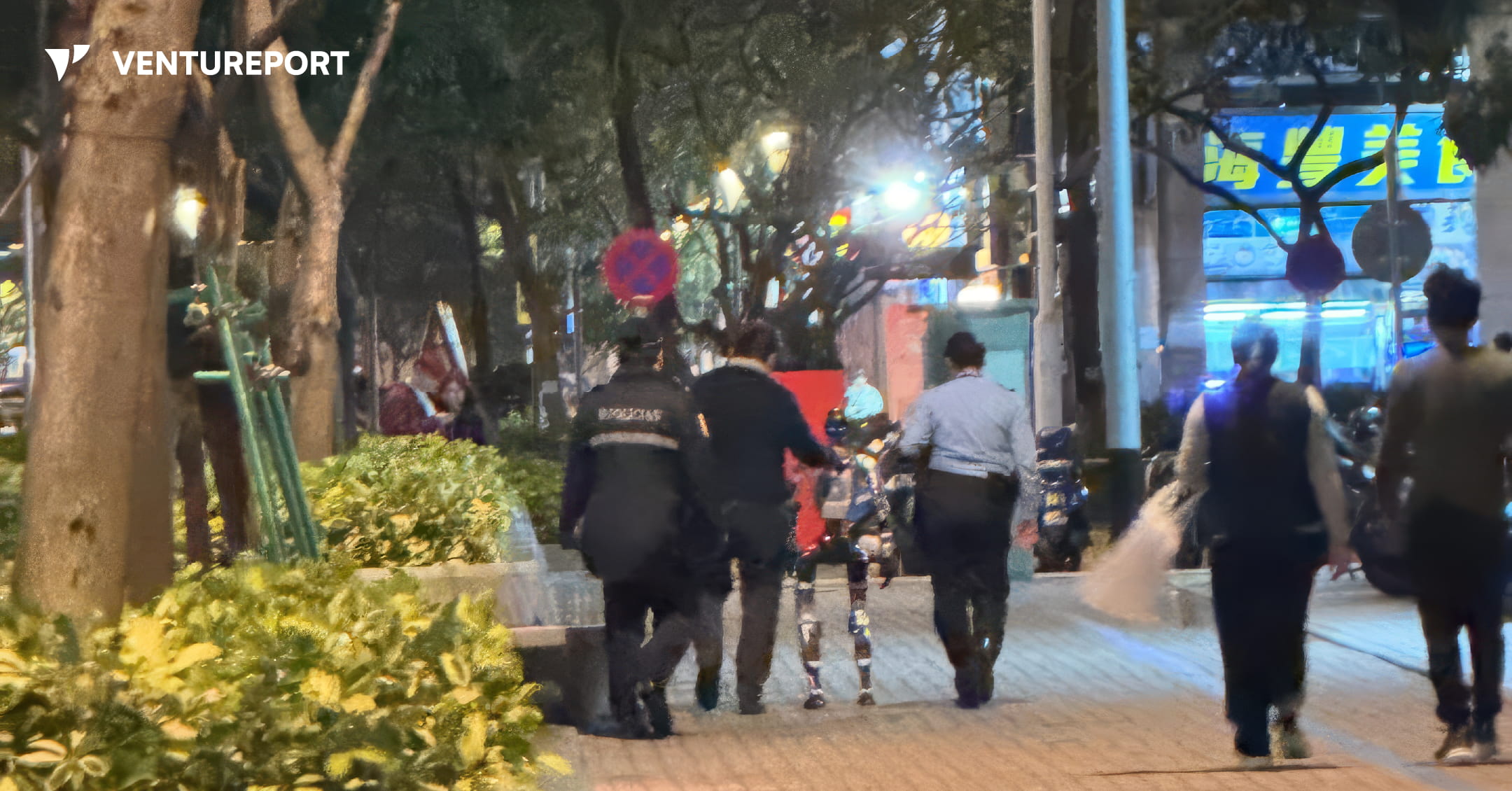
Macau police officer accompanying the humanoid robot. PHOTO: THREADS@BOXOF_CHOCOLATE
Police in Macau recently detained a humanoid robot after it frightened an elderly woman on a public street. The unusual encounter quickly spread online, prompting jokes about what some called the world’s first “robot arrest”.
On the evening of March 5, the robot was taken away by officers after the encounter triggered alarm among bystanders. Videos circulating on social media show an elderly woman confronting the robot on a sidewalk, visibly distressed and shouting that her “heart is pounding” while demanding to know why such “nonsense” was happening on the street. In the clip, the robot raises both hands toward the woman after she lashes out in fear — a gesture many viewers interpreted as a sign of apology.
Shortly afterwards, two officers from the Macau Public Security Police Force were seen escorting the robot and a man believed to be its operator away from the area. An officer is seen placing his right hand on the robot’s shoulder — the same posture police often use when presenting arrested suspects in official photographs.
That scene quickly spread online, fuelling jokes about what some called the world’s first “robot arrest”.
Photos shared online show a humanoid robot with long limbs and exposed mechanical joints, built from a black metallic frame without an outer shell. In dim lighting, several commenters said it resembled a “moving skeleton” — a striking sight for pedestrians encountering it unexpectedly on the street.
Witnesses said the woman appeared severely shaken and an ambulance was eventually called to take her to the hospital.
The incident also sparked discussion online about robots operating in public spaces. Some commenters argued that experimental technologies should be tested in controlled environments, while others said machines moving through public areas should have clearer designs or safety measures to avoid alarming pedestrians.
It remains unclear who deployed the robot or what purpose it was serving in the area at the time of the incident. Authorities have not released further details about the device or whether any action was taken following the encounter.
Keep Reading
Can SPhotonix’s optical memory technology protect data better than today’s storage?
Updated
January 8, 2026 6:32 PM

SPhotonix's 5D Memory Crystals™. PHOTO: SPHOTONIX
SPhotonix, a young deep-tech startup, is working on something unexpected for the data storage world: tiny, glass-like crystals that can hold enormous amounts of information for extremely long periods of time. The company works where light and data meet, using photonics—the science of shaping and guiding light—to build optical components and explore a new form of memory called “5D optical storage”.
It’s based on research that began more than twenty years ago, when Professor Peter Kazansky showed that a small crystal could preserve data—from the human genome to the entire Wikipedia—essentially forever.
Their new US$4.5 million pre-seed round, led by Creator Fund and XTX Ventures, is meant to turn that science into real products. And the timing aligns with a growing problem: the world is generating far more digital data than current storage systems can handle. Most of it isn’t needed every day, but it can’t be thrown away either. This long-term, rarely accessed cold data is piling up faster than existing storage infrastructure can manage and maintaining giant warehouses of servers just to keep it all alive is becoming expensive and environmentally unsustainable.
This is the problem SPhotonix is stepping in to solve. They want to store huge amounts of information in a stable format that doesn’t degrade, doesn’t need electricity to preserve data and doesn’t require constant swapping of hardware. Instead of racks of spinning drives, the idea is a durable optical crystal storage system that could last for generations.
The company’s underlying technology—called FemtoEtch™—uses ultrafast lasers to engrave microscopic patterns inside fused silica. These precisely etched structures can function as high-performance optical components for fields like aerospace, microscopy and semiconductor manufacturing. But the same ultra-controlled process can also encode information in five dimensions within the crystal, transforming the material into a compact, long-lasting archive capable of holding massive amounts of information in a very small footprint.
The new funding allows SPhotonix to expand its engineering team, grow its R&D facility in Switzerland and prepare the technology for real-world deployment. Investors say the opportunity is significant: global data generation has more than doubled in recent years and traditional storage systems—drives, disks, tapes—weren’t designed for the scale or longevity modern data demands.
While the company has been gaining attention in research circles (and even made an appearance in the latest Mission Impossible film), its next step is all about practical adoption. If the technology reaches commercial viability, it could offer an alternative to the energy-hungry, short-lived storage hardware that underpins much of today’s digital infrastructure.
As digital information continues to multiply, preserving it safely and sustainably is becoming one of the biggest challenges in modern computing. SPhotonix’s work points toward a future where long-lasting, low-maintenance optical data storage becomes a practical alternative to today’s fragile systems. It offers a more resilient way to preserve knowledge for the decades ahead.