
A humanoid robot being escorted away by police in Macau has gone viral online, prompting jokes about what some called the world’s first “robot arrest.”
Updated
March 13, 2026 2:04 PM
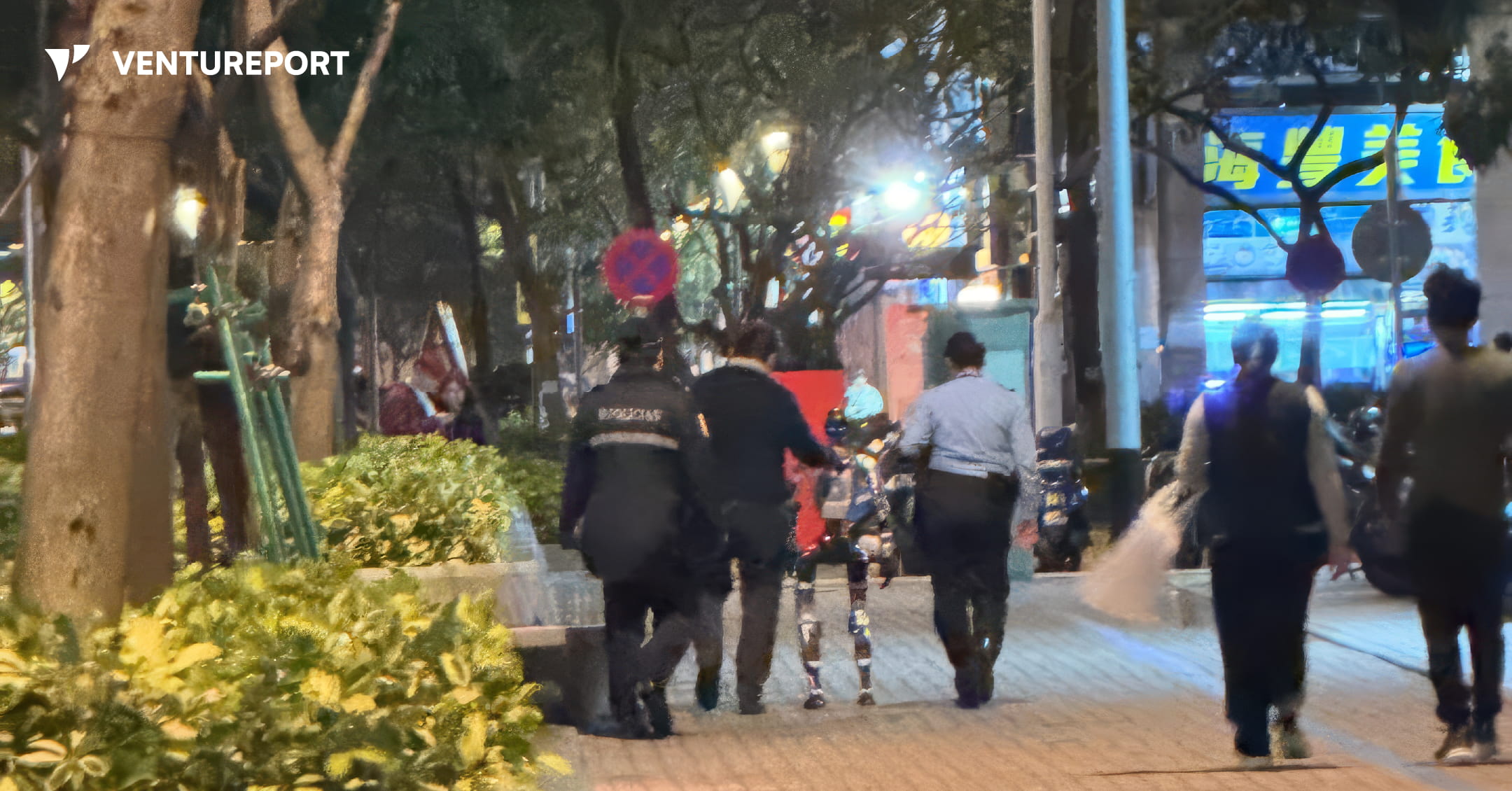
Macau police officer accompanying the humanoid robot. PHOTO: THREADS@BOXOF_CHOCOLATE
Police in Macau recently detained a humanoid robot after it frightened an elderly woman on a public street. The unusual encounter quickly spread online, prompting jokes about what some called the world’s first “robot arrest”.
On the evening of March 5, the robot was taken away by officers after the encounter triggered alarm among bystanders. Videos circulating on social media show an elderly woman confronting the robot on a sidewalk, visibly distressed and shouting that her “heart is pounding” while demanding to know why such “nonsense” was happening on the street. In the clip, the robot raises both hands toward the woman after she lashes out in fear — a gesture many viewers interpreted as a sign of apology.
Shortly afterwards, two officers from the Macau Public Security Police Force were seen escorting the robot and a man believed to be its operator away from the area. An officer is seen placing his right hand on the robot’s shoulder — the same posture police often use when presenting arrested suspects in official photographs.
That scene quickly spread online, fuelling jokes about what some called the world’s first “robot arrest”.
Photos shared online show a humanoid robot with long limbs and exposed mechanical joints, built from a black metallic frame without an outer shell. In dim lighting, several commenters said it resembled a “moving skeleton” — a striking sight for pedestrians encountering it unexpectedly on the street.
Witnesses said the woman appeared severely shaken and an ambulance was eventually called to take her to the hospital.
The incident also sparked discussion online about robots operating in public spaces. Some commenters argued that experimental technologies should be tested in controlled environments, while others said machines moving through public areas should have clearer designs or safety measures to avoid alarming pedestrians.
It remains unclear who deployed the robot or what purpose it was serving in the area at the time of the incident. Authorities have not released further details about the device or whether any action was taken following the encounter.
Keep Reading
The hidden cost of scaling AI: infrastructure, energy, and the push for liquid cooling.
Updated
January 8, 2026 6:31 PM

The inside of a data centre, with rows of server racks. PHOTO: FREEPIK
As artificial intelligence models grow larger and more demanding, the quiet pressure point isn’t the algorithms themselves—it’s the AI infrastructure that has to run them. Training and deploying modern AI models now requires enormous amounts of computing power, which creates a different kind of challenge: heat, energy use and space inside data centers. This is the context in which Supermicro and NVIDIA’s collaboration on AI infrastructure begins to matter.
Supermicro designs and builds large-scale computing systems for data centers. It has now expanded its support for NVIDIA’s Blackwell generation of AI chips with new liquid-cooled server platforms built around the NVIDIA HGX B300. The announcement isn’t just about faster hardware. It reflects a broader effort to rethink how AI data center infrastructure is built as facilities strain under rising power and cooling demands.
At a basic level, the systems are designed to pack more AI chips into less space while using less energy to keep them running. Instead of relying mainly on air cooling—fans, chillers and large amounts of electricity, these liquid-cooled AI servers circulate liquid directly across critical components. That approach removes heat more efficiently, allowing servers to run denser AI workloads without overheating or wasting energy.
Why does that matter outside a data center? Because AI doesn’t scale in isolation. As models become more complex, the cost of running them rises quickly, not just in hardware budgets, but in electricity use, water consumption and physical footprint. Traditional air-cooling methods are increasingly becoming a bottleneck, limiting how far AI systems can grow before energy and infrastructure costs spiral.
This is where the Supermicro–NVIDIA partnership fits in. NVIDIA supplies the computing engines—the Blackwell-based GPUs designed to handle massive AI workloads. Supermicro focuses on how those chips are deployed in the real world: how many GPUs can fit in a rack, how they are cooled, how quickly systems can be assembled and how reliably they can operate at scale in modern data centers. Together, the goal is to make high-density AI computing more practical, not just more powerful.
The new liquid-cooled designs are aimed at hyperscale data centers and so-called AI factories—facilities built specifically to train and run large AI models continuously. By increasing GPU density per rack and removing most of the heat through liquid cooling, these systems aim to ease a growing tension in the AI boom: the need for more computers without an equally dramatic rise in energy waste.
Just as important is speed. Large organizations don’t want to spend months stitching together custom AI infrastructure. Supermicro’s approach packages compute, networking and cooling into pre-validated data center building blocks that can be deployed faster. In a world where AI capabilities are advancing rapidly, time to deployment can matter as much as raw performance.
Stepping back, this development says less about one product launch and more about a shift in priorities across the AI industry. The next phase of AI growth isn’t only about smarter models—it’s about whether the physical infrastructure powering AI can scale responsibly. Efficiency, power use and sustainability are becoming as critical as speed.