
A humanoid robot being escorted away by police in Macau has gone viral online, prompting jokes about what some called the world’s first “robot arrest.”
Updated
March 13, 2026 2:04 PM
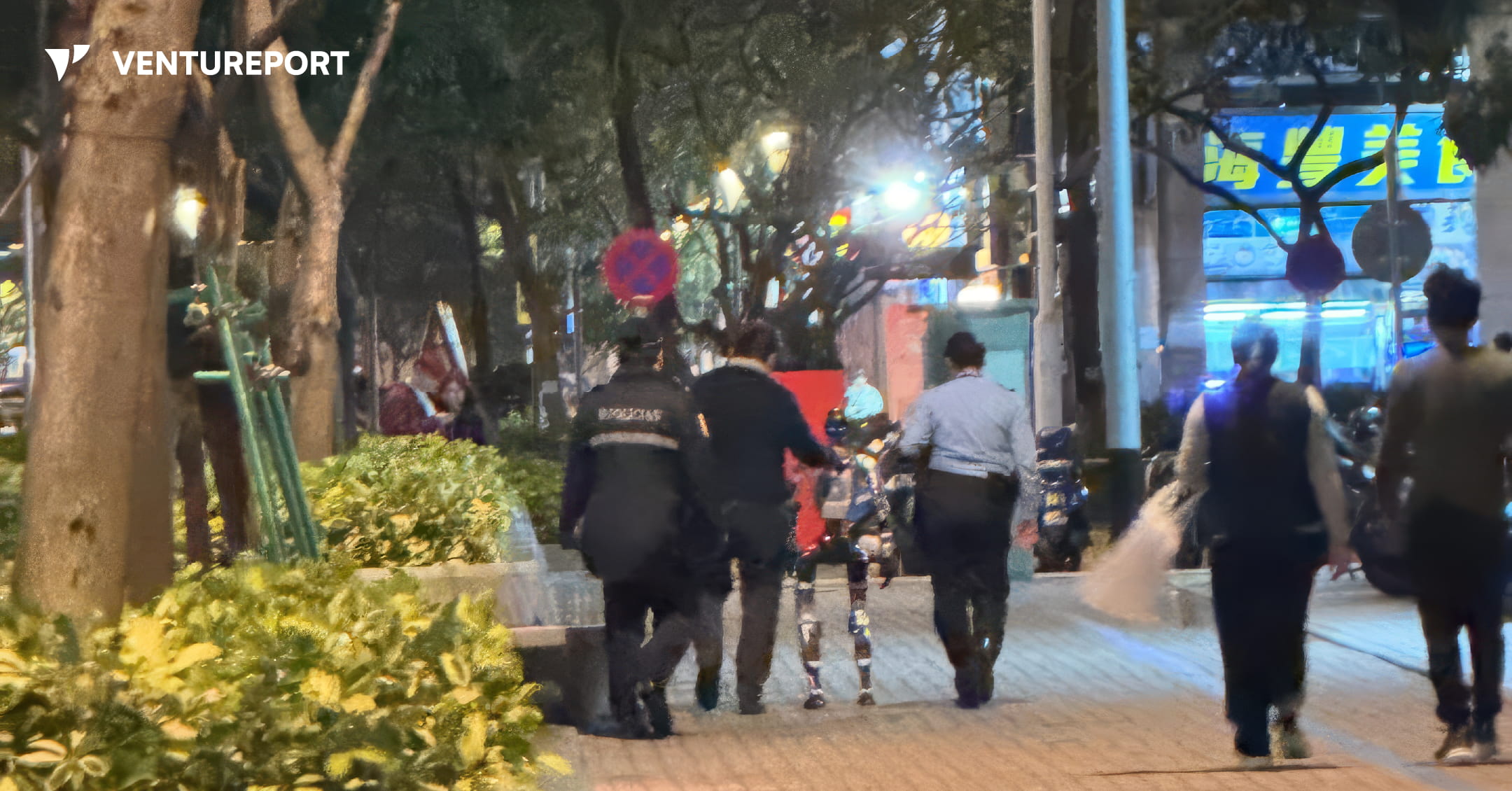
Macau police officer accompanying the humanoid robot. PHOTO: THREADS@BOXOF_CHOCOLATE
Police in Macau recently detained a humanoid robot after it frightened an elderly woman on a public street. The unusual encounter quickly spread online, prompting jokes about what some called the world’s first “robot arrest”.
On the evening of March 5, the robot was taken away by officers after the encounter triggered alarm among bystanders. Videos circulating on social media show an elderly woman confronting the robot on a sidewalk, visibly distressed and shouting that her “heart is pounding” while demanding to know why such “nonsense” was happening on the street. In the clip, the robot raises both hands toward the woman after she lashes out in fear — a gesture many viewers interpreted as a sign of apology.
Shortly afterwards, two officers from the Macau Public Security Police Force were seen escorting the robot and a man believed to be its operator away from the area. An officer is seen placing his right hand on the robot’s shoulder — the same posture police often use when presenting arrested suspects in official photographs.
That scene quickly spread online, fuelling jokes about what some called the world’s first “robot arrest”.
Photos shared online show a humanoid robot with long limbs and exposed mechanical joints, built from a black metallic frame without an outer shell. In dim lighting, several commenters said it resembled a “moving skeleton” — a striking sight for pedestrians encountering it unexpectedly on the street.
Witnesses said the woman appeared severely shaken and an ambulance was eventually called to take her to the hospital.
The incident also sparked discussion online about robots operating in public spaces. Some commenters argued that experimental technologies should be tested in controlled environments, while others said machines moving through public areas should have clearer designs or safety measures to avoid alarming pedestrians.
It remains unclear who deployed the robot or what purpose it was serving in the area at the time of the incident. Authorities have not released further details about the device or whether any action was taken following the encounter.
Keep Reading
From TV to YouTube, the Oscars’ global shift reveals how entertainment, access and platforms are reshaping cultural institutions.
Updated
January 8, 2026 6:29 PM

Youtube app on a mobile device. PHOTO: UNSPLASH
The Oscars are moving to YouTube. Beginning in 2029, the Academy of Motion Picture Arts and Sciences has signed a multi-year agreement that makes YouTube the exclusive global home of the Oscars through 2033. From the ceremony itself to red carpet coverage, behind-the-scenes access and the Governors Ball, the entire experience will live on a platform most people already open every day.
On the surface, it looks like a distribution shift. In reality, it signals a broader strategic reset. For decades, television delivered scale for cultural institutions. Today, reach and discovery live on platforms, not channels. By choosing YouTube, the Academy is quietly acknowledging that cultural relevance today is built where audiences already are. In that context, YouTube is no longer just a place to watch clips but an emerging piece of cultural infrastructure.
What also stands out is how the Oscars are being reframed. This partnership is not limited to one night a year. Alongside the ceremony, YouTube will host year-round Academy programming through the Oscars YouTube channel. That includes nominations announcements, the Governors Awards, the Student Academy Awards, the Scientific and Technical Awards, filmmaker interviews, podcasts and education programs. Instead of a single broadcast moment, the Oscars are turning into an always-on ecosystem.
Accessibility is another central pillar of the deal. The Oscars will be free to watch globally, supported by closed captioning and audio tracks in multiple languages. This is less about nice-to-have features and more about staying relevant in a global, digital-first world. Younger audiences and viewers outside traditional Western markets expect access by default. The Academy is clearly building with that expectation in mind.
There is also a deeper exchange happening between heritage and technology. YouTube gains cultural weight by hosting one of the world’s most established creative institutions. The Academy, in turn, gains technological legitimacy and a clearer path into the future.
That balance extends to how the transition is being handled. The Academy’s domestic broadcast partnership with Disney ABC will continue through the 100th Oscars in 2028 and the international arrangement with Disney’s Buena Vista International remains in place until then. This is not an abrupt break from legacy media but a carefully phased shift. Change is being managed without burning bridges.
“We are thrilled to enter into a multifaceted global partnership with YouTube to be the future home of the Oscars and our year-round Academy programming,” said Academy CEO Bill Kramer and Academy President Lynette Howell Taylor. “The Academy is an international organization and this partnership will allow us to expand access to the work of the Academy to the largest worldwide audience possible — which will be beneficial for our Academy members and the film community. This collaboration will leverage YouTube’s vast reach and infuse the Oscars and other Academy programming with innovative opportunities for engagement while honoring our legacy. We will be able to celebrate cinema, inspire new generations of filmmakers and provide access to our film history on an unprecedented global scale.”
From YouTube’s side, the partnership places the platform firmly in the center of global cultural moments. “The Oscars are one of our essential cultural institutions, honoring excellence in storytelling and artistry,” said Neal Mohan, CEO, YouTube. “Partnering with the Academy to bring this celebration of art and entertainment to viewers all over the world will inspire a new generation of creativity and film lovers while staying true to the Oscars’ storied legacy.”
Google Arts & Culture extends the partnership beyond the ceremony. Select Academy Museum exhibitions and materials from the Academy’s 52-million-item collection will be made digitally accessible worldwide, bringing film history and education onto the same platform.
Taken together, the deal is less about where the Oscars will stream and more about how cultural institutions are adapting to the changing landscape. The Academy is positioning itself to be present year-round, globally accessible and aligned with the platforms that shape everyday viewing.