
A humanoid robot being escorted away by police in Macau has gone viral online, prompting jokes about what some called the world’s first “robot arrest.”
Updated
March 12, 2026 5:11 PM
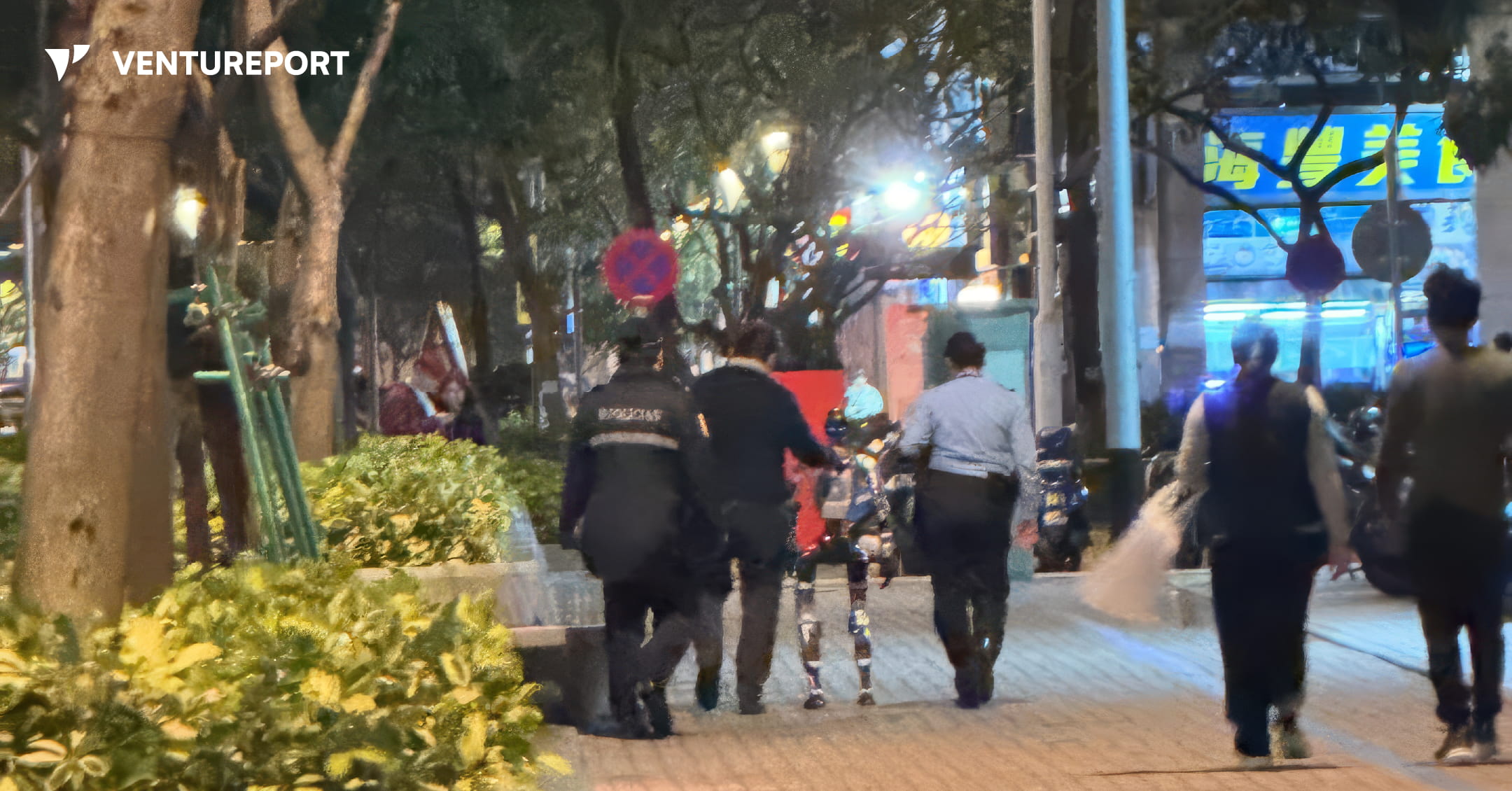
Macau police officer accompanying the humanoid robot. PHOTO: THREADS
Police in Macau recently detained a humanoid robot after it frightened an elderly woman on a public street. The unusual encounter quickly spread online, prompting jokes about what some called the world’s first “robot arrest”.
On the evening of March 5, the robot was taken away by officers after the encounter triggered alarm among bystanders. Videos circulating on social media show an elderly woman confronting the robot on a sidewalk, visibly distressed and shouting that her “heart is pounding” while demanding to know why such “nonsense” was happening on the street. In the clip, the robot raises both hands toward the woman after she lashes out in fear — a gesture many viewers interpreted as a sign of apology.
Shortly afterwards, two officers from the Macau Public Security Police Force were seen escorting the robot and a man believed to be its operator away from the area. An officer is seen placing his right hand on the robot’s shoulder — the same posture police often use when presenting arrested suspects in official photographs.
That scene quickly spread online, fuelling jokes about what some called the world’s first “robot arrest”.
Photos shared online show a humanoid robot with long limbs and exposed mechanical joints, built from a black metallic frame without an outer shell. In dim lighting, several commenters said it resembled a “moving skeleton” — a striking sight for pedestrians encountering it unexpectedly on the street.
Witnesses said the woman appeared severely shaken and an ambulance was eventually called to take her to the hospital.
The incident also sparked discussion online about robots operating in public spaces. Some commenters argued that experimental technologies should be tested in controlled environments, while others said machines moving through public areas should have clearer designs or safety measures to avoid alarming pedestrians.
It remains unclear who deployed the robot or what purpose it was serving in the area at the time of the incident. Authorities have not released further details about the device or whether any action was taken following the encounter.
Keep Reading
Structured AI interviews and human judgment combine to address the global talent shortage
Updated
March 4, 2026 4:46 PM

ManpowerGroup World Headquarters in Milwaukee. PHOTO: ADOBE STOCK
As hiring pressures mount across global markets, ManpowerGroup is turning to technology to strengthen how it connects people to work. The workforce solutions major has announced a global partnership with Hubert, a startup focused on AI-driven structured interviews. The aim is simple: make hiring faster and fairer, without removing the human touch.
ManpowerGroup has spent decades operating at the center of the global labor market. The company works with employers across industries to fill roles, manage workforce planning and build talent pipelines. With millions of placements each year, it has a clear view of how strained hiring has become. A large share of employers today report difficulty finding skilled talent. At the same time, candidates expect more transparency, quicker feedback and flexibility in how they engage with employers.
Hubert enters this picture as a specialist in structured digital interviewing. The startup has built tools that allow candidates to complete interviews online, at any time, while being assessed against consistent criteria. Instead of relying on informal screening calls or resume filters, its system focuses on standardized questions tied directly to job requirements. The idea is to bring more consistency to early-stage hiring.
The partnership brings these capabilities into ManpowerGroup’s global operations. AI-powered interviews will now support the first stage of screening, helping recruiters identify qualified candidates earlier in the process. This does not replace recruiters. Final decisions and contextual judgment remain with experienced hiring professionals. What changes is the speed and structure of the initial assessment.
For employers, this could mean earlier visibility into job-ready talent and less time spent on manual screening. For candidates, it offers more flexibility. A significant portion of interviews on Hubert’s platform are completed outside regular office hours, allowing applicants to engage when it suits them. That flexibility can make a difference in competitive labor markets where timing matters.
The collaboration is also positioned as a step toward reducing bias. By evaluating each candidate against the same transparent standards, the process becomes more consistent. While no system can remove bias entirely, structured assessments can reduce the variability that often comes with unstructured interviews.
At its core, the partnership addresses a gap many large organizations are facing. They need scale and speed, but they cannot afford to lose the human judgment that good hiring depends on. Manual processes are too slow. Fully automated systems can feel impersonal and risky. ManpowerGroup’s approach suggests a middle path, where technology handles repetition and structure and recruiters focus on potential and fit.
The move also reflects a broader shift in the workforce industry. AI is no longer being tested on the sidelines. It is being built into the foundation of hiring operations. For established players like ManpowerGroup, the challenge is not whether to adopt AI, but how to do so responsibly and at scale.
By working with Hubert, the company is signaling that the future of recruitment will likely blend structured digital tools with human expertise. In a market defined by talent shortages and rising expectations, that balance may prove critical.