
A humanoid robot being escorted away by police in Macau has gone viral online, prompting jokes about what some called the world’s first “robot arrest.”
Updated
March 13, 2026 2:04 PM
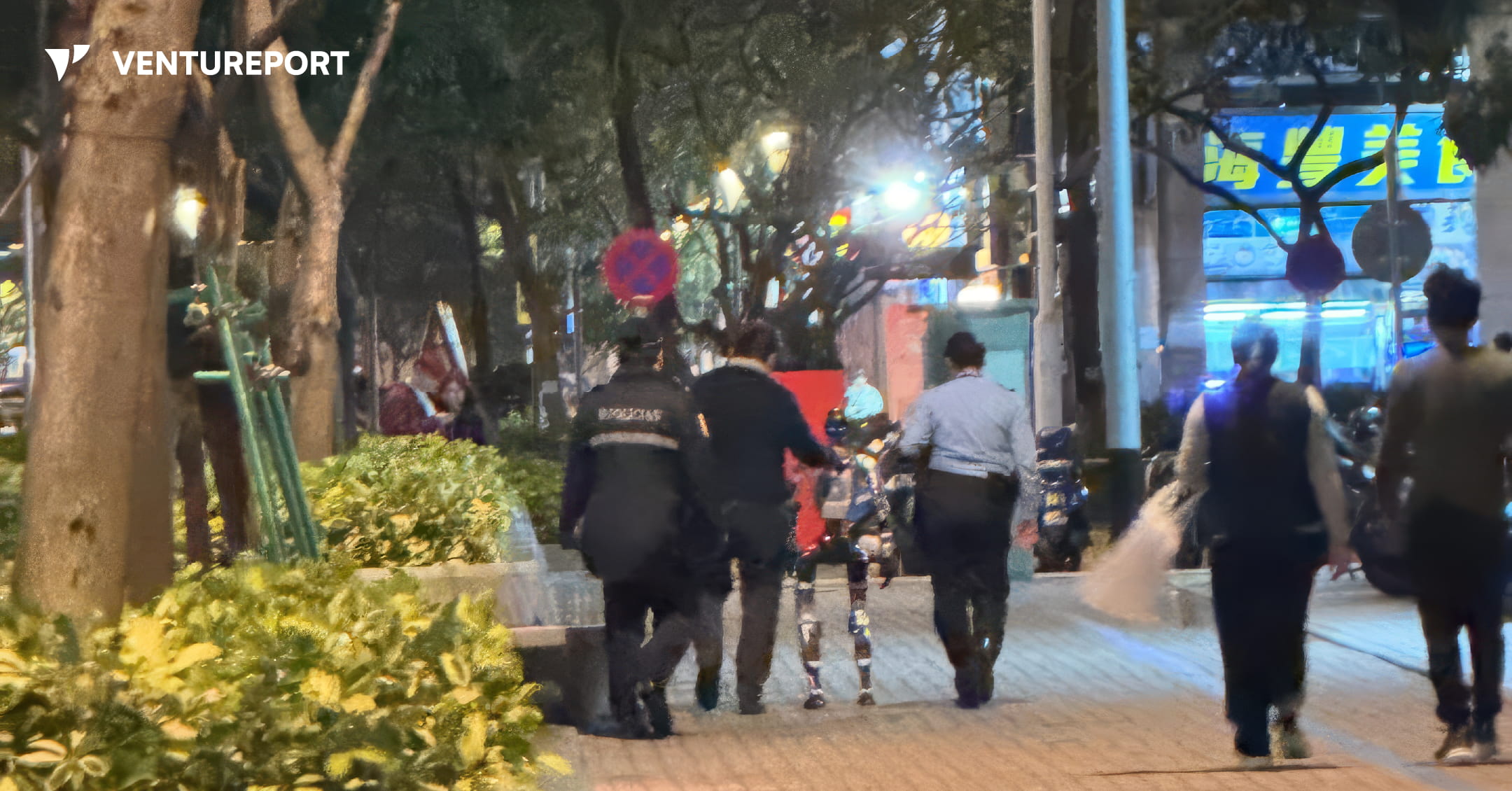
Macau police officer accompanying the humanoid robot. PHOTO: THREADS@BOXOF_CHOCOLATE
Police in Macau recently detained a humanoid robot after it frightened an elderly woman on a public street. The unusual encounter quickly spread online, prompting jokes about what some called the world’s first “robot arrest”.
On the evening of March 5, the robot was taken away by officers after the encounter triggered alarm among bystanders. Videos circulating on social media show an elderly woman confronting the robot on a sidewalk, visibly distressed and shouting that her “heart is pounding” while demanding to know why such “nonsense” was happening on the street. In the clip, the robot raises both hands toward the woman after she lashes out in fear — a gesture many viewers interpreted as a sign of apology.
Shortly afterwards, two officers from the Macau Public Security Police Force were seen escorting the robot and a man believed to be its operator away from the area. An officer is seen placing his right hand on the robot’s shoulder — the same posture police often use when presenting arrested suspects in official photographs.
That scene quickly spread online, fuelling jokes about what some called the world’s first “robot arrest”.
Photos shared online show a humanoid robot with long limbs and exposed mechanical joints, built from a black metallic frame without an outer shell. In dim lighting, several commenters said it resembled a “moving skeleton” — a striking sight for pedestrians encountering it unexpectedly on the street.
Witnesses said the woman appeared severely shaken and an ambulance was eventually called to take her to the hospital.
The incident also sparked discussion online about robots operating in public spaces. Some commenters argued that experimental technologies should be tested in controlled environments, while others said machines moving through public areas should have clearer designs or safety measures to avoid alarming pedestrians.
It remains unclear who deployed the robot or what purpose it was serving in the area at the time of the incident. Authorities have not released further details about the device or whether any action was taken following the encounter.
Keep Reading
Sensing technology is facilitating the transition of drone delivery services from trial phases to regular daily operations.
Updated
January 23, 2026 10:41 AM

A quadcopter drone with package attached. PHOTO: FREEPIK
A new partnership between Hesai Technology, a LiDAR solutions company and Keeta Drone, an urban delivery platform under Meituan, offers a glimpse into how drone delivery is moving from experimentation to real-world scale.
Under the collaboration, Hesai will supply solid-state LiDAR sensors for Keeta’s next-generation delivery drones. The goal is to make everyday drone deliveries more reliable as they move from trials to routine operations. Keeta Drone operates in a challenging space—low-altitude urban airspace. Its drones deliver food, medicine and emergency supplies across cities such as Beijing, Shanghai, Hong Kong and Dubai. With more than 740,000 deliveries completed across 65 routes, the company has discontinued testing the concept. It is scaling it. For that scale to work, drones must be able to navigate crowded environments filled with buildings, trees, power lines and unpredictable conditions. This is where Hesai’s technology comes in.
Hesai’s solid-state LiDAR is integrated into Keeta's latest long-range delivery drones. LiDAR stands for Light Detection and Ranging. In simple terms, it is a sensing technology that helps machines understand their surroundings by sending out laser pulses and measuring how they bounce back. Unlike GPS, LiDAR does not rely solely on satellites to determine position. Instead, it gives drones a direct sense of their surroundings, helping them spot small but critical obstacles like wires or tree branches.
In a recent demonstration, Keeta Drone completed a nighttime flight using LiDAR-based navigation alone without relying on cameras or satellite positioning. This shows how the technology can support stable operations even when visibility is poor or GPS signals are limited.
The LiDAR system used in these drones is Hesai’s second-generation solid-state model known as FTX. Compared with earlier versions, the sensor offers higher resolution while being smaller and lighter—important considerations for airborne systems where weight and space are limited. The updated design also reduces integration complexity, making it easier to incorporate into commercial drone platforms. Large-scale production of the sensor is expected to begin in 2026.
From Hesai’s perspective, delivery drones are one of several forms robots are expected to take in the coming decades. Industry forecasts suggest robots will increasingly appear in many roles from industrial systems to service applications, with drones becoming a familiar part of urban infrastructure rather than a novelty.
For Keeta Drone, this improves safety and reliability. And for the broader industry, it signals that drone logistics is entering a more mature phase—one defined less by experimentation and more by dependable execution. Taken together, the partnership highlights a practical evolution in drone delivery.
As cities grow more complex, the question is no longer whether drones can fly but whether they can do so reliably, safely and at scale. At its core, this partnership is not about drones or sensors as products. It is about what it takes to make a complex system work quietly in real cities. As drone delivery moves out of pilot zones and into everyday use, reliability matters more than novelty.