
A humanoid robot being escorted away by police in Macau has gone viral online, prompting jokes about what some called the world’s first “robot arrest.”
Updated
March 13, 2026 2:04 PM
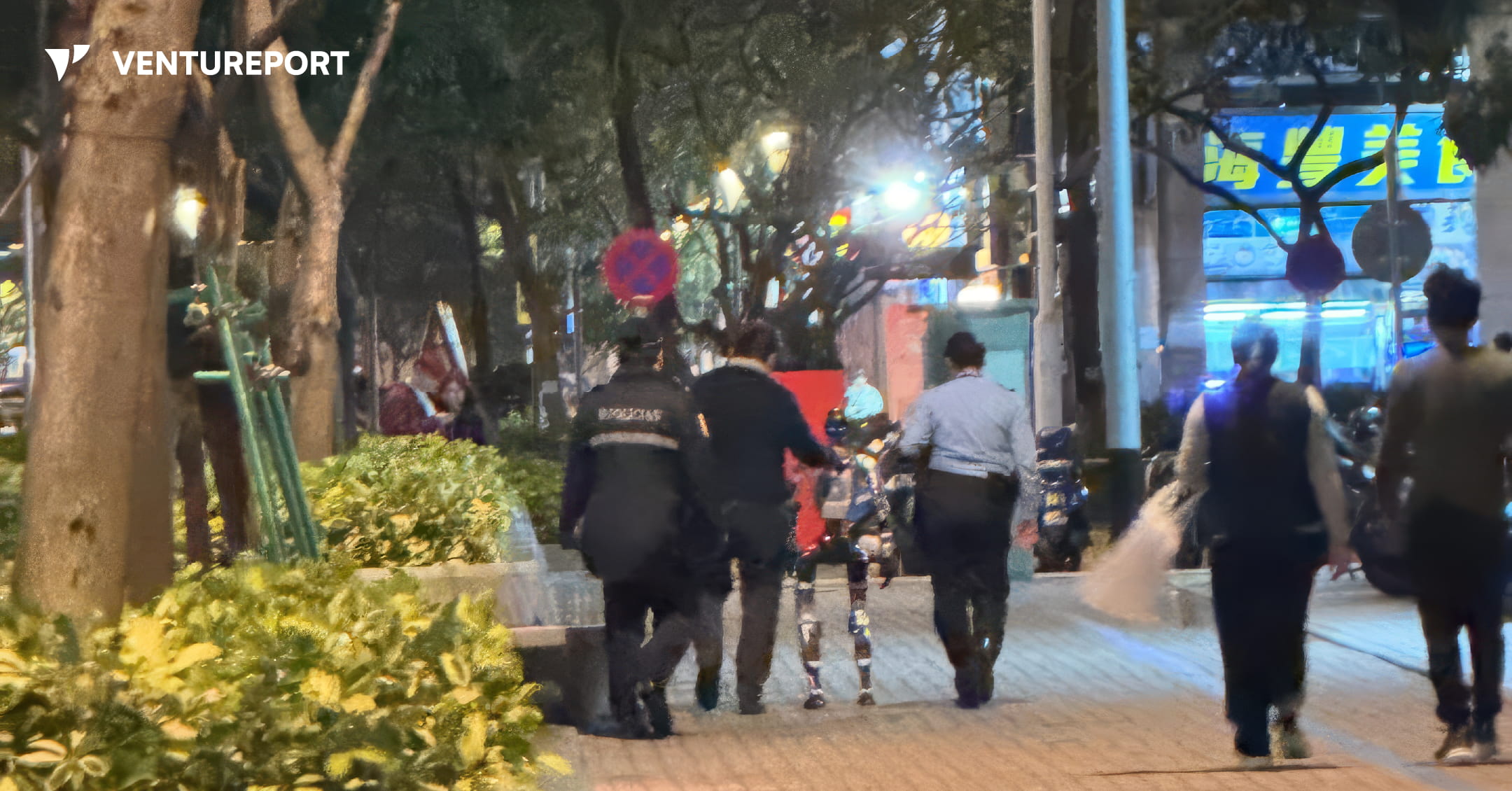
Macau police officer accompanying the humanoid robot. PHOTO: THREADS@BOXOF_CHOCOLATE
Police in Macau recently detained a humanoid robot after it frightened an elderly woman on a public street. The unusual encounter quickly spread online, prompting jokes about what some called the world’s first “robot arrest”.
On the evening of March 5, the robot was taken away by officers after the encounter triggered alarm among bystanders. Videos circulating on social media show an elderly woman confronting the robot on a sidewalk, visibly distressed and shouting that her “heart is pounding” while demanding to know why such “nonsense” was happening on the street. In the clip, the robot raises both hands toward the woman after she lashes out in fear — a gesture many viewers interpreted as a sign of apology.
Shortly afterwards, two officers from the Macau Public Security Police Force were seen escorting the robot and a man believed to be its operator away from the area. An officer is seen placing his right hand on the robot’s shoulder — the same posture police often use when presenting arrested suspects in official photographs.
That scene quickly spread online, fuelling jokes about what some called the world’s first “robot arrest”.
Photos shared online show a humanoid robot with long limbs and exposed mechanical joints, built from a black metallic frame without an outer shell. In dim lighting, several commenters said it resembled a “moving skeleton” — a striking sight for pedestrians encountering it unexpectedly on the street.
Witnesses said the woman appeared severely shaken and an ambulance was eventually called to take her to the hospital.
The incident also sparked discussion online about robots operating in public spaces. Some commenters argued that experimental technologies should be tested in controlled environments, while others said machines moving through public areas should have clearer designs or safety measures to avoid alarming pedestrians.
It remains unclear who deployed the robot or what purpose it was serving in the area at the time of the incident. Authorities have not released further details about the device or whether any action was taken following the encounter.
Keep Reading
HyveGeo’s approach to restoring degraded land stands out at the FoodTech Challenge
Updated
February 7, 2026 2:18 PM

Clusters of sandstone buttes in Monument Valley, Colorado Plateau. PHOTO: UNSPLASH
HyveGeo, a climate-focused startup, has been named one of the global winners of the FoodTech Challenge, an international competition designed to surface practical technologies that strengthen food systems in arid and climate-stressed regions.
The FoodTech Challenge (FTC) is based in the UAE and brings together governments, foundations and agri-food institutions to identify early-stage solutions that address food production, land degradation and resource efficiency. Each year, hundreds of startups apply from around the world. In 2026, more than 1,200 teams from 113 countries submitted entries. Only four were selected.
HyveGeo stood out for its approach to one of agriculture’s hardest problems: how to make desert soil usable again. Founded in 2023 by a group of scientists and researchers, the Abu Dhabi-based company focuses on regenerating degraded land using a process built around biochar, a carbon-rich material made from agricultural waste, enhanced with microalgae. The aim is to accelerate soil recovery in environments where water is limited and land has been heavily stressed.
What caught the judges’ attention was not just the technology itself, but the way it links several challenges at once. The system turns waste into a usable soil input, reduces the time it takes for land to become productive and locks carbon into the ground instead of releasing it into the atmosphere. In short, it addresses land degradation, food production and climate pressure through a single framework.
As a winner of the FoodTech Challenge, HyveGeo will share a US$2 million prize with the other selected startups. Beyond funding, the company will also receive support from the UAE’s innovation ecosystem, including research backing, pilot projects, market access and incubation services to help move from testing into wider deployment.
The team’s plans focus on scaling within the UAE first. HyveGeo aims to work across Abu Dhabi’s network of farms and gradually expand into other arid and climate-stressed regions. Its longer-term target is to restore thousands of hectares of degraded land and contribute to carbon removal through soil-based methods.
Placed in a broader context, HyveGeo’s win reflects a shift in how food and climate technologies are being evaluated. Instead of chasing dramatic breakthroughs, competitions like the FTC are increasingly backing systems that connect waste, land, water and carbon into something usable on the ground. Not futuristic agriculture, but practical repair work for environments that can no longer rely on old farming assumptions. If that direction continues, the next wave of food innovation may be less about spectacle and more about quiet, scalable fixes for places where growing food has become hardest.