
A humanoid robot being escorted away by police in Macau has gone viral online, prompting jokes about what some called the world’s first “robot arrest.”
Updated
March 13, 2026 2:04 PM
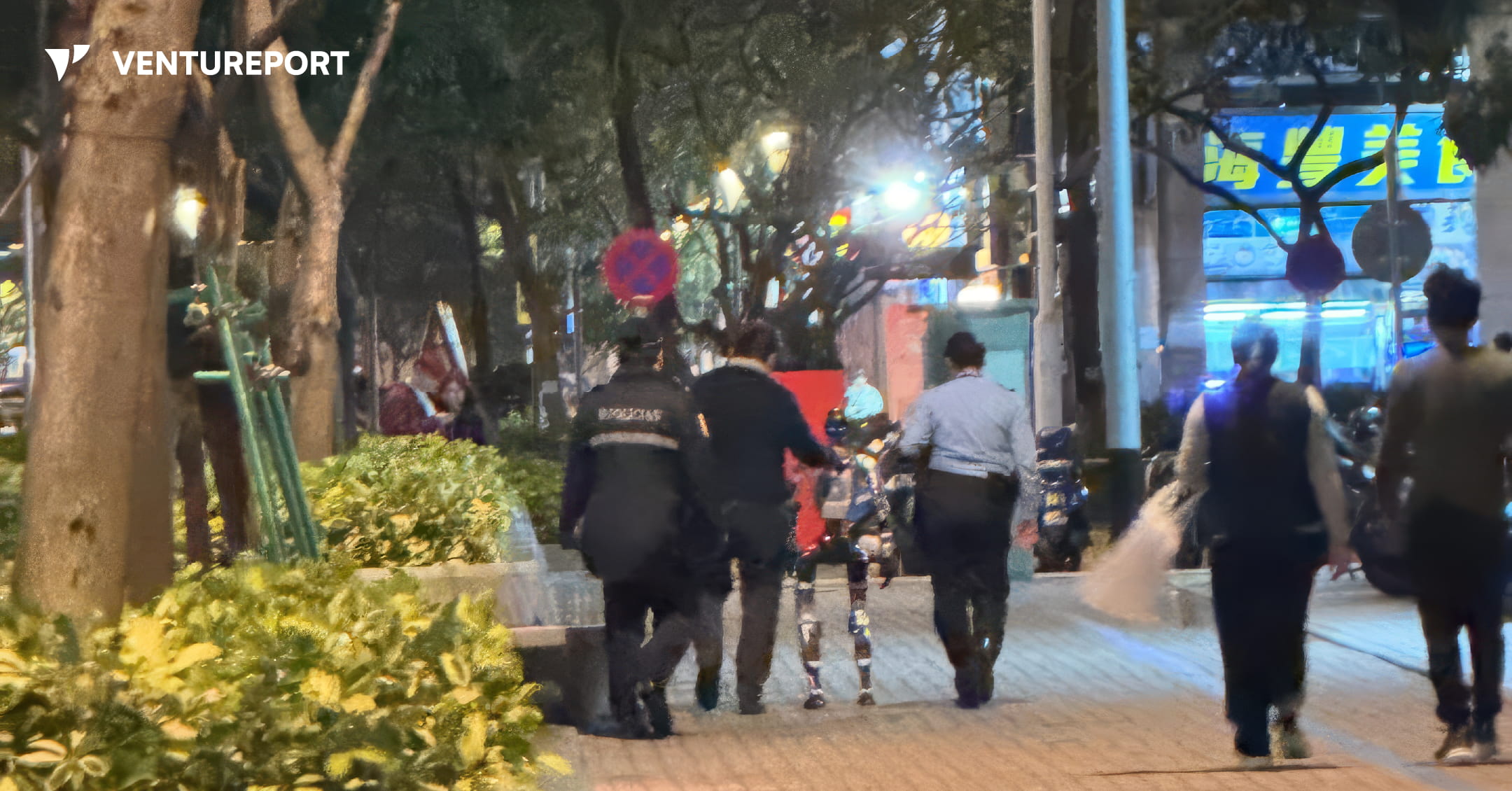
Macau police officer accompanying the humanoid robot. PHOTO: THREADS@BOXOF_CHOCOLATE
Police in Macau recently detained a humanoid robot after it frightened an elderly woman on a public street. The unusual encounter quickly spread online, prompting jokes about what some called the world’s first “robot arrest”.
On the evening of March 5, the robot was taken away by officers after the encounter triggered alarm among bystanders. Videos circulating on social media show an elderly woman confronting the robot on a sidewalk, visibly distressed and shouting that her “heart is pounding” while demanding to know why such “nonsense” was happening on the street. In the clip, the robot raises both hands toward the woman after she lashes out in fear — a gesture many viewers interpreted as a sign of apology.
Shortly afterwards, two officers from the Macau Public Security Police Force were seen escorting the robot and a man believed to be its operator away from the area. An officer is seen placing his right hand on the robot’s shoulder — the same posture police often use when presenting arrested suspects in official photographs.
That scene quickly spread online, fuelling jokes about what some called the world’s first “robot arrest”.
Photos shared online show a humanoid robot with long limbs and exposed mechanical joints, built from a black metallic frame without an outer shell. In dim lighting, several commenters said it resembled a “moving skeleton” — a striking sight for pedestrians encountering it unexpectedly on the street.
Witnesses said the woman appeared severely shaken and an ambulance was eventually called to take her to the hospital.
The incident also sparked discussion online about robots operating in public spaces. Some commenters argued that experimental technologies should be tested in controlled environments, while others said machines moving through public areas should have clearer designs or safety measures to avoid alarming pedestrians.
It remains unclear who deployed the robot or what purpose it was serving in the area at the time of the incident. Authorities have not released further details about the device or whether any action was taken following the encounter.
Keep Reading
From plush figures to digital pets, a new class of AI toys is emerging — built not around screens or sensors, but around memory, language and emotional awareness
Updated
February 5, 2026 2:00 PM

Spielwarenmesse toy fair. PHOTO: SPIELWARENMESSE
Spielwarenmesse in Nuremberg is the global meeting point for the toy industry, where brands and designers preview what will shape how children play and learn next. At this year’s fair, one message stood out clearly: toys are no longer built just to entertain, but to listen, respond and grow with children. Tuya Smart, a global AI cloud platform company, used the event to show how AI-powered toys are turning familiar formats into interactive companions that can talk, react emotionally and adapt over time.
The company’s central argument was simple but far-reaching. The next generation of artificial intelligence toys will not be defined by motors, sensors or screens alone, but by how well they understand human behavior. Instead of being single-function objects, smart toys for children are becoming systems that combine language models, emotion recognition and memory to support ongoing interaction.
One of the most talked-about examples was Tuya Smart’s Nebula Plush AI Toy. At first glance, it looks like a soft, expressive plush figure. Inside, it uses emotional recognition to change its LED facial expressions in real time. If a child sounds sad or excited, the toy’s eyes respond visually. It supports natural conversation, reacts to hugs and touch and combines storytelling, news-style updates and interactive games. Over time, it builds memory, allowing it to behave less like a gadget and more like an interactive AI toy that recalls past interactions.
Another example was Walulu, also developed using Tuya’s AI toy platform. Walulu is an AI pet built around personalization. It can detect up to 19 emotional states and speak more than 60 languages. It connects to major large language models such as ChatGPT, Gemini, DeepSeek, Qwen and Doubao. Through simple app-based controls, users choose traits like cheerful, quiet, curious or thoughtful. Those choices shape how Walulu talks and reacts. Instead of repeating scripts, it adjusts its tone and behavior over time. The result is not a novelty item, but an emotionally responsive AI toy that feels consistent in daily use.
Tuya also showed how educational AI toys can extend into learning and exploration. Its AI Learning Camera blends computer vision with interactive content. When it recognizes an object, it links it to cultural and learning material. If a child points it at a foreign word, it offers real-time pronunciation and translation. It can also turn drawings into digital artwork, encouraging active creativity rather than passive screen time. In this sense, AI toys for kids are becoming tools for learning as much as play.
These products point to a larger strategy. Tuya is not just making toys — it is building the AI toy development platform behind them. Through its AI Toy Solution, developers can design a toy’s personality, memory logic and behavior without training models from scratch. The system integrates with leading AI models and supports multi-turn conversation and emotional feedback, turning standard hardware into responsive AI companions.
The platform supports multiple development paths. Brands can use ready-to-market OEM solutions, add AI to existing products or build custom toys around their own characters. Plush toys, robots, educational tools and wearables can all become AI-powered toys without changing their physical design.
Because these products are made for children and families, safety is built in. Tuya’s system includes parental controls, conversation history review and content management. It supports standards such as GDPR and CCPA with encryption and data localization.
From a business standpoint, Tuya’s pitch is speed and scale. The company says its AI toy infrastructure can cut development time by more than half and reduce R&D costs by up to 50 percent. Its AIoT network spans over 200 countries and supports more than 60 languages, making global deployment of AI toys easier.
What emerged at Spielwarenmesse 2026 was not just a lineup of smart gadgets, but a clear shift in the category. AI toys are evolving into emotionally aware systems that talk, listen, remember and adapt. Their value lies not in sounding clever, but in fitting naturally into everyday life.
The fair did not present AI toys as a distant future. It showed them as products already entering the mainstream. The real question now is not whether toys will use AI, but how carefully that intelligence is designed for children.