
A humanoid robot being escorted away by police in Macau has gone viral online, prompting jokes about what some called the world’s first “robot arrest.”
Updated
March 13, 2026 2:04 PM
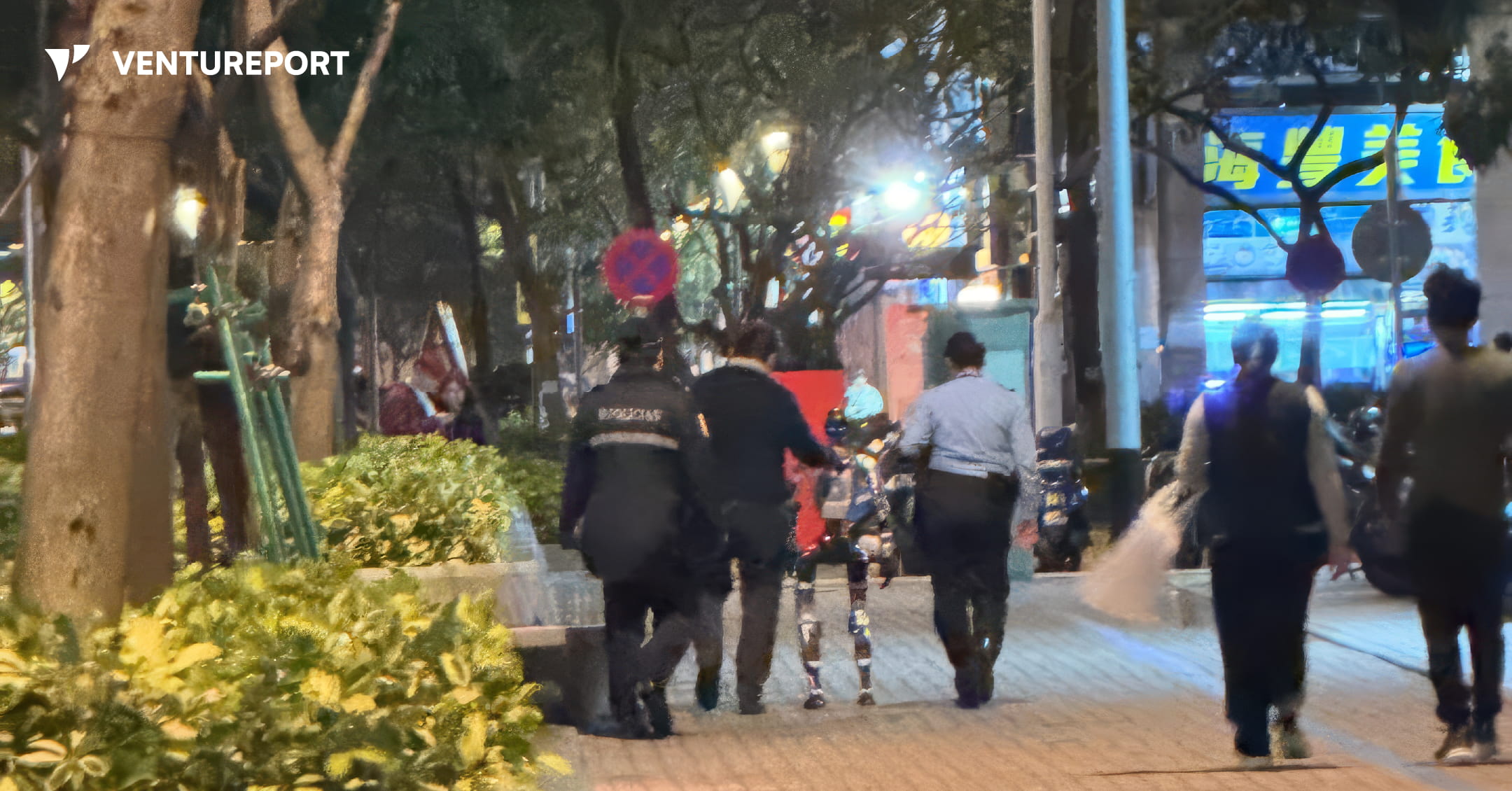
Macau police officer accompanying the humanoid robot. PHOTO: THREADS@BOXOF_CHOCOLATE
Police in Macau recently detained a humanoid robot after it frightened an elderly woman on a public street. The unusual encounter quickly spread online, prompting jokes about what some called the world’s first “robot arrest”.
On the evening of March 5, the robot was taken away by officers after the encounter triggered alarm among bystanders. Videos circulating on social media show an elderly woman confronting the robot on a sidewalk, visibly distressed and shouting that her “heart is pounding” while demanding to know why such “nonsense” was happening on the street. In the clip, the robot raises both hands toward the woman after she lashes out in fear — a gesture many viewers interpreted as a sign of apology.
Shortly afterwards, two officers from the Macau Public Security Police Force were seen escorting the robot and a man believed to be its operator away from the area. An officer is seen placing his right hand on the robot’s shoulder — the same posture police often use when presenting arrested suspects in official photographs.
That scene quickly spread online, fuelling jokes about what some called the world’s first “robot arrest”.
Photos shared online show a humanoid robot with long limbs and exposed mechanical joints, built from a black metallic frame without an outer shell. In dim lighting, several commenters said it resembled a “moving skeleton” — a striking sight for pedestrians encountering it unexpectedly on the street.
Witnesses said the woman appeared severely shaken and an ambulance was eventually called to take her to the hospital.
The incident also sparked discussion online about robots operating in public spaces. Some commenters argued that experimental technologies should be tested in controlled environments, while others said machines moving through public areas should have clearer designs or safety measures to avoid alarming pedestrians.
It remains unclear who deployed the robot or what purpose it was serving in the area at the time of the incident. Authorities have not released further details about the device or whether any action was taken following the encounter.
Keep Reading
The focus is no longer just AI-generated worlds, but how those worlds become structured digital products
Updated
February 20, 2026 6:50 PM

The inside of a pair of HTC VR goggles. PHOTO: UNSPLASH
As AI tools improve, creating 3D content is becoming faster and easier. However, building that content into interactive experiences still requires time, structure and technical work. That difference between generation and execution is where HTC VIVERSE and World Labs are focusing their new collaboration.
HTC VIVERSE is a 3D content platform developed by HTC. It provides creators with tools to build, refine and publish interactive virtual environments. Meanwhile, World Labs is an AI startup founded by researcher Fei-Fei Li and a team of machine learning specialists. The company recently introduced Marble, a tool that generates full 3D environments from simple text, image or video prompts.
While Marble can quickly create a digital world, that world on its own is not yet a finished experience. It still needs structure, navigation and interaction. This is where VIVERSE fits in. By combining Marble’s world generation with VIVERSE’s building tools, creators can move from an AI-generated scene to a usable, interactive product.
In practice, the workflow works in two steps. First, Marble produces the base 3D environment. Then, creators bring that environment into VIVERSE, where they add game mechanics, scenes and interactive elements. In this model, AI handles the early visual creation, while the human creator defines how users explore and interact with the world.
To demonstrate this process, the companies developed three example projects. Whiskerhill turns a Marble-generated world into a simple quest-based experience. Whiskerport connects multiple AI-generated scenes into a multi-level environment that users navigate through portals. Clockwork Conspiracy, built by VIVERSE, uses Marble’s generation system to create a more structured, multi-scene game. These projects are not just demos. They serve as proof that AI-generated worlds can evolve beyond static visuals and become interactive environments.
This matters because generative AI is often judged by how quickly it produces content. However, speed alone does not create usable products. Digital experiences still require sequencing, design decisions and user interaction. As a result, the real challenge is not generation, but integration — connecting AI output to tools that make it functional.
Seen in this context, the collaboration is less about a single product and more about workflow. VIVERSE provides a system that allows AI-generated environments to be edited and structured. World Labs provides the engine that creates those environments in the first place. Together, they are testing whether AI can fit directly into a full production pipeline rather than remain a standalone tool.
Ultimately, the collaboration reflects a broader change in creative technology. AI is no longer only producing isolated assets. It is beginning to plug into the larger process of building complete experiences. The key question is no longer how quickly a world can be generated, but how easily that world can be turned into something people can actually use and explore.