
Where smarter storage meets smarter logistics.
Updated
January 8, 2026 6:32 PM
.jpg)
Kioxia's flagship building at Yokohama Technology Campus. PHOTO: KIOXIA
E-commerce keeps growing and with it, the number of products moving through warehouses every day. Items vary more than ever — different shapes, seasonal packaging, limited editions and constantly updated designs. At the same time, many logistics centers are dealing with labour shortages and rising pressure to automate.
But today’s image-recognition AI isn’t built for this level of change. Most systems rely on deep-learning models that need to be adjusted or retrained whenever new products appear. Every update — whether it’s a new item or a packaging change — adds extra time, energy use and operational cost. And for warehouses handling huge product catalogs, these retraining cycles can slow everything down.
KIOXIA, a company known for its memory and storage technologies, is working on a different approach. In a new collaboration with Tsubakimoto Chain and EAGLYS, the team has developed an AI-based image recognition system that is designed to adapt more easily as product lines grow and shift. The idea is to help logistics sites automatically identify items moving through their workflows without constantly reworking the core AI model.
At the center of the system is KIOXIA’s AiSAQ software paired with its Memory-Centric AI technology. Instead of retraining the model each time new products appear, the system stores new product data — images, labels and feature information — directly in high-capacity storage. This allows warehouses to add new items quickly without altering the original AI model.
Because storing more data can lead to longer search times, the system also indexes the stored product information and transfers the index into SSD storage. This makes it easier for the AI to retrieve relevant features fast, using a Retrieval-Augmented Generation–style method adapted for image recognition.
The collaboration will be showcased at the 2025 International Robot Exhibition in Tokyo. Visitors will see the system classify items in real time as they move along a conveyor, drawing on stored product features to identify them instantly. The demonstration aims to illustrate how logistics sites can handle continuously changing inventories with greater accuracy and reduced friction.
Overall, as logistics networks become increasingly busy and product lines evolve faster than ever, this memory-driven approach provides a practical way to keep automation adaptable and less fragile.
Keep Reading
How a Korean biotech startup is using AI to move drug discovery from trial-and-error to precision design
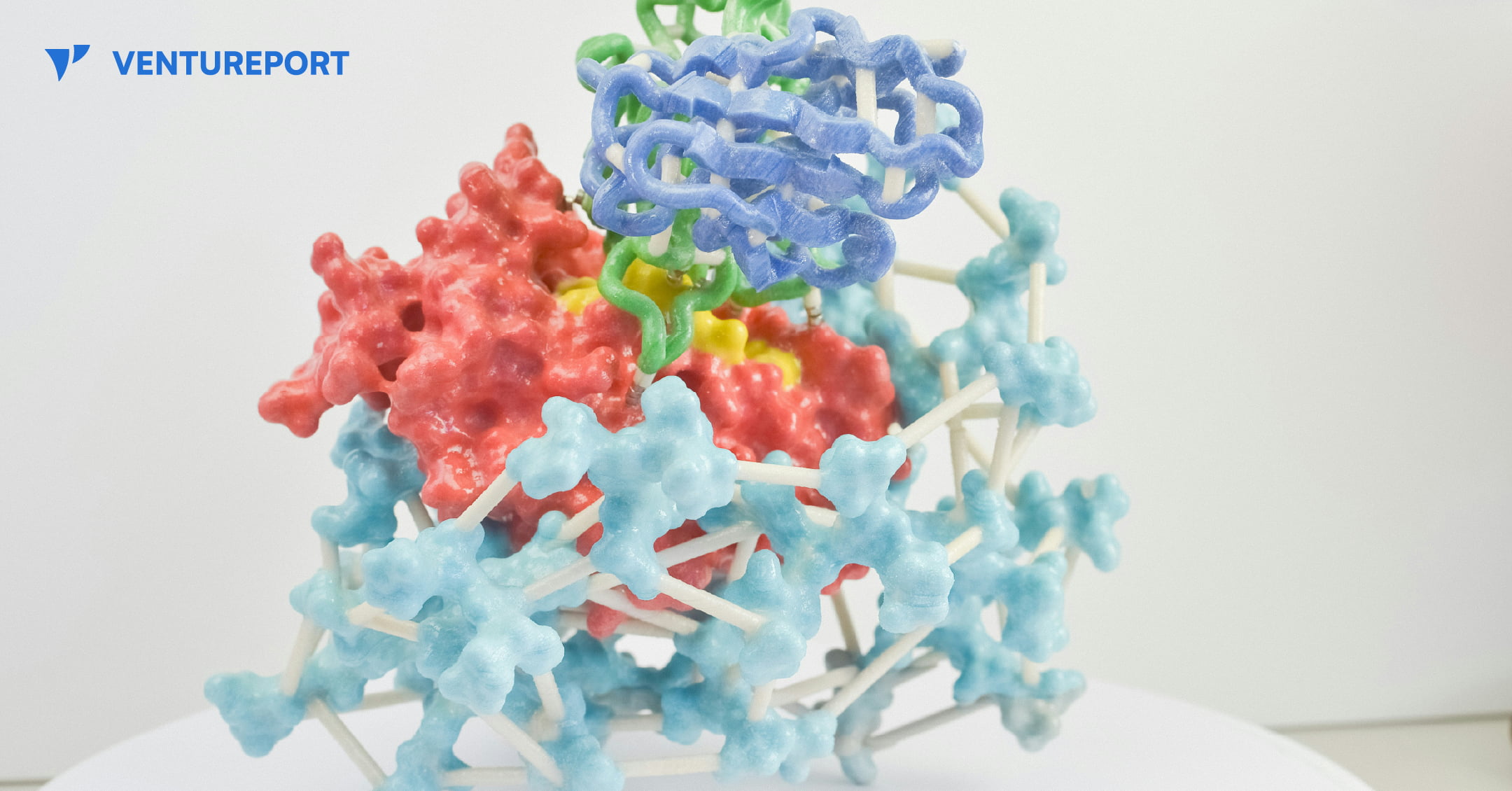
A close up of a protein structure model. PHOTO: UNSPLASH
For decades, drug discovery has relied on trial and error, with scientists testing thousands of molecules to find one that works. Galux, a South Korean biotech startup, is changing that by using AI to design proteins from scratch. This method, called “de novo” design, makes it possible to build precise new therapies instead of searching through existing ones.
The company recently announced a US$29 million Series B funding round, bringing its total capital to US$47 million.This significant investment attracted a substantial roster of institutional backers, including the Korea Development Bank (KDB), Yuanta Investment, SL Investment and NCORE Ventures. These firms joined existing investors such as InterVest, DAYLI Partners and PATHWAY Investment, as well as new participants including SneakPeek Investments, Korea Investment & Securities and Mirae Asset Securities.
At the core of the company’s work is a platform called GaluxDesign. Unlike many AI tools that only predict how existing proteins fold, this system uses deep learning and physics to create entirely new therapeutic antibodies. This “from scratch” approach lets the team go after so-called “undruggable” proteins. These are targets that traditional small-molecule drugs can’t reach because they lack clear binding pockets. By designing proteins to fit these complex shapes, Galux aims to unlock treatments that have stayed out of reach for decades. And that’s exactly why investors are paying attention.
The pharmaceutical industry is actively looking for faster and more efficient ways to develop new drugs, and Galux is built for exactly that. The company connects its AI platform directly to its own wet lab, where designs can be tested in real time. Each result feeds straight back into the system, sharpening the next round of models. This continuous loop speeds up discovery and improves precision at every step. It’s also why partners like Celltrion, LG Chem and Boehringer Ingelheim are already working with Galux.
Galux is no longer just trying to make drugs that stick to a target. The company now wants its AI to design medicines that actually work in the body and can be made at scale. In simple terms, a drug has to do more than bind to a disease—it must be stable, safe and strong enough to change how the illness behaves. Galux is moving into tougher targets such as ion channels and GPCRs. These play key roles in heart function and sensory signals. Ultimately, the goal is to show that AI-driven design can turn complex biology into real treatments. And instead of hunting blindly for a solution, the team is building exactly what they need.