
A turbine-inspired generator shows how overlooked industrial airflow could quietly become a new source of usable power
Updated
February 3, 2026 11:23 AM

Campus building of Chung-Ang University. PHOTO: CHUNG-ANG UNIVERSITY
Compressed air is used across factories, data centers and industrial plants to move materials, cool systems and power tools. Once it has done that job, the air is usually released — and its remaining energy goes unused.
That everyday waste is what caught the attention of a research team at Chung-Ang University in South Korea. They are investigating how this overlooked airflow can be harnessed to generate electricity instead of disappearing into the background.
Most of the world’s power today comes from systems like turbines, which turn moving fluids into energy or solar cells, which convert sunlight into electricity. The Chung-Ang team has built a device that uses compressed air to generate electricity without relying on traditional blades or sunlight.
At the center of the work is a simple question: what happens when high-pressure air spins through a specially shaped device at very high speed? The answer lies in the air itself. The researchers found that tiny particles naturally present in the air carry an electric charge. When that air moves rapidly across certain surfaces, it can transfer charge without physical contact. This creates electricity through a process known as the “particulate static effect.”
To use that effect, the team designed a generator based on a Tesla turbine. Unlike conventional turbines with blades, a Tesla turbine uses smooth rotating disks and relies on the viscosity of air to create motion. Compressed air enters the device, spins the disks at high speed and triggers charge buildup on specially layered surfaces inside.
What makes this approach different is that the system does not depend on friction between parts rubbing together. Instead, the charge comes from particles in the air interacting with the surfaces as they move past. This reduces wear and allows the generator to operate at very high speeds. And those speeds translate into real output.
In lab tests, the device produced strong electrical power. The researchers also showed that this energy could be used in practical ways. It ran small electronic devices, helped pull moisture from the air and removed dust particles from its surroundings.
The problem this research is addressing is straightforward.
Compressed air is already everywhere in industry, but its leftover energy is usually ignored. This system is designed to capture part of that unused motion and convert it into electricity without adding complex equipment or major safety risks.
Earlier methods of harvesting static electricity from particles showed promise, but they came with dangers. Uncontrolled discharge could cause sparks or even ignition. By using a sealed, turbine-based structure, the Chung-Ang University team offers a safer and more stable way to apply the same physical effect.
As a result, the technology is still in the research stage, but its direction is easy to see. It points toward a future where energy is not only generated in power plants or stored in batteries, but also recovered from everyday industrial processes.
Keep Reading
Rethinking 3D modelling for a world that generates too much, too quickly.
Updated
January 8, 2026 6:32 PM
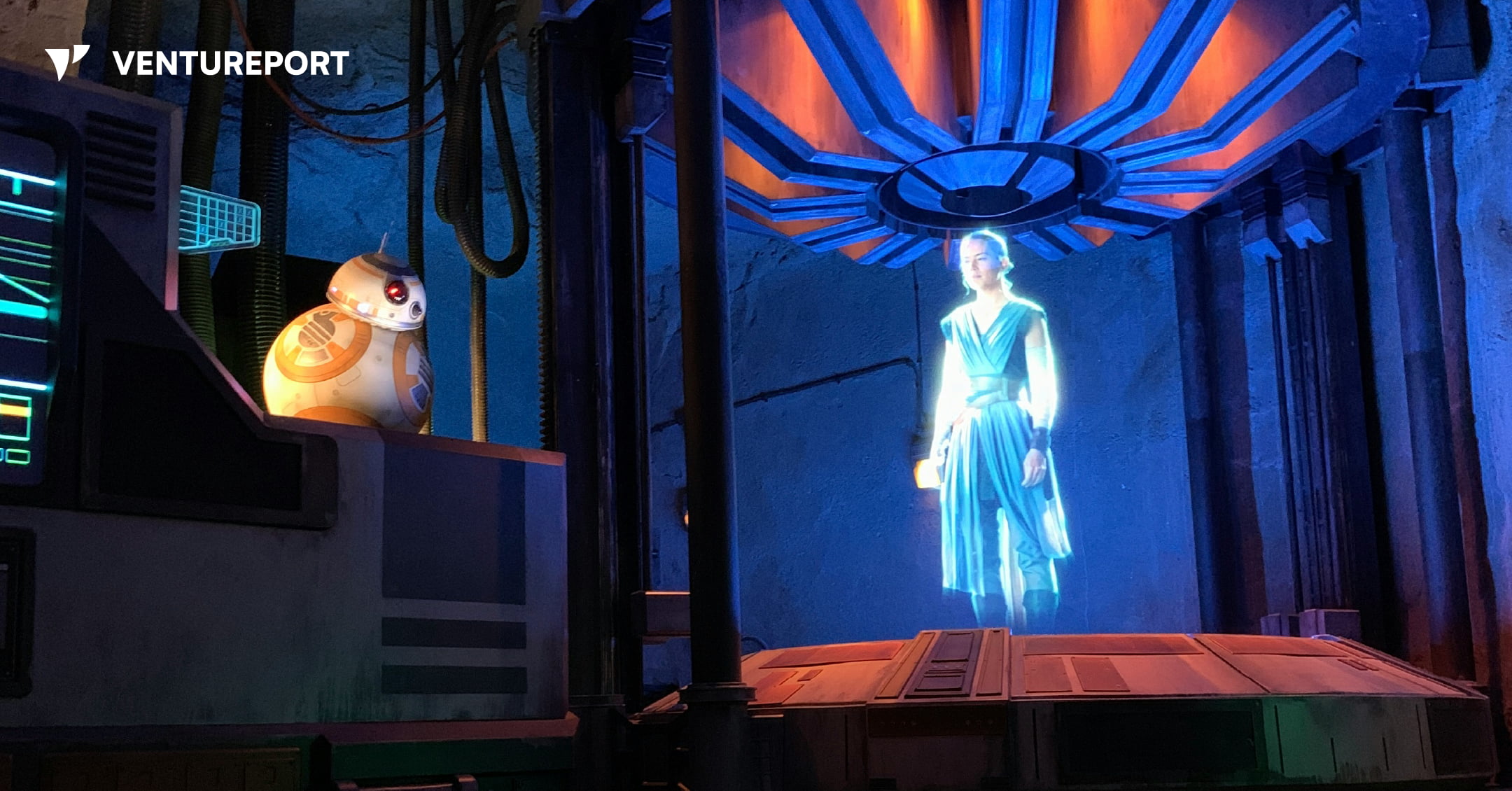
A hologram in the franchise Star Wars, in Walt Disney World Resort, Orlando. PHOTO: UNSPLASH
MicroCloud Hologram Inc. (NASDAQ: HOLO), a technology service provider recognized for its holography and imaging systems, is now expanding into a more advanced realm: a quantum-driven 3D intelligent model. The goal is to generate detailed 3D models and images with far less manual effort — a need that has only grown as industries flood the world with more visual data every year.
The concept is straightforward, even if the technology behind it isn’t. Traditional 3D modeling workflows are slow, fragmented and depend on large teams to clean datasets, train models, adjust parameters and fine-tune every output. HOLO is trying to close that gap by combining quantum computing with AI-powered 3D modeling, enabling the system to process massive datasets quickly and automatically produce high-precision 3D assets with much less human involvement.
To achieve this, the company developed a distributed architecture comprising of several specialized subsystems. One subsystem collects and cleans raw visual data from different sources. Another uses quantum deep learning to understand patterns in that data. A third converts the trained model into ready-to-use 3D assets based on user inputs. Additional modules manage visualization, secure data storage and system-wide protection — all supported by quantum-level encryption. Each subsystem runs in its own container and communicates through encrypted interfaces, allowing flexible upgrades and scaling without disrupting the entire system.
Why this matters: Industries ranging from gaming and film to manufacturing, simulation and digital twins are rapidly increasing their reliance on 3D content. The real bottleneck isn’t creativity — it’s time. Producing accurate, high-quality 3D assets still requires a huge amount of manual processing. HOLO’s approach attempts to lighten that workload by utilizing quantum tools to speed up data processing, model training, generation and scaling, while keeping user data secure.
According to the company, the system’s biggest advantages include its ability to handle massive datasets more efficiently, generate precise 3D models with fewer manual steps, and scale easily thanks to its modular, quantum-optimized design. Whether quantum computing will become a mainstream part of 3D production remains an open question. Still, the model shows how companies are beginning to rethink traditional 3D workflows as demand for high-quality digital content continues to surge.