
Bitmo Lab is testing an ultra-thin, bendable tracker built to fit inside items traditional trackers can’t
Updated
February 12, 2026 4:43 PM
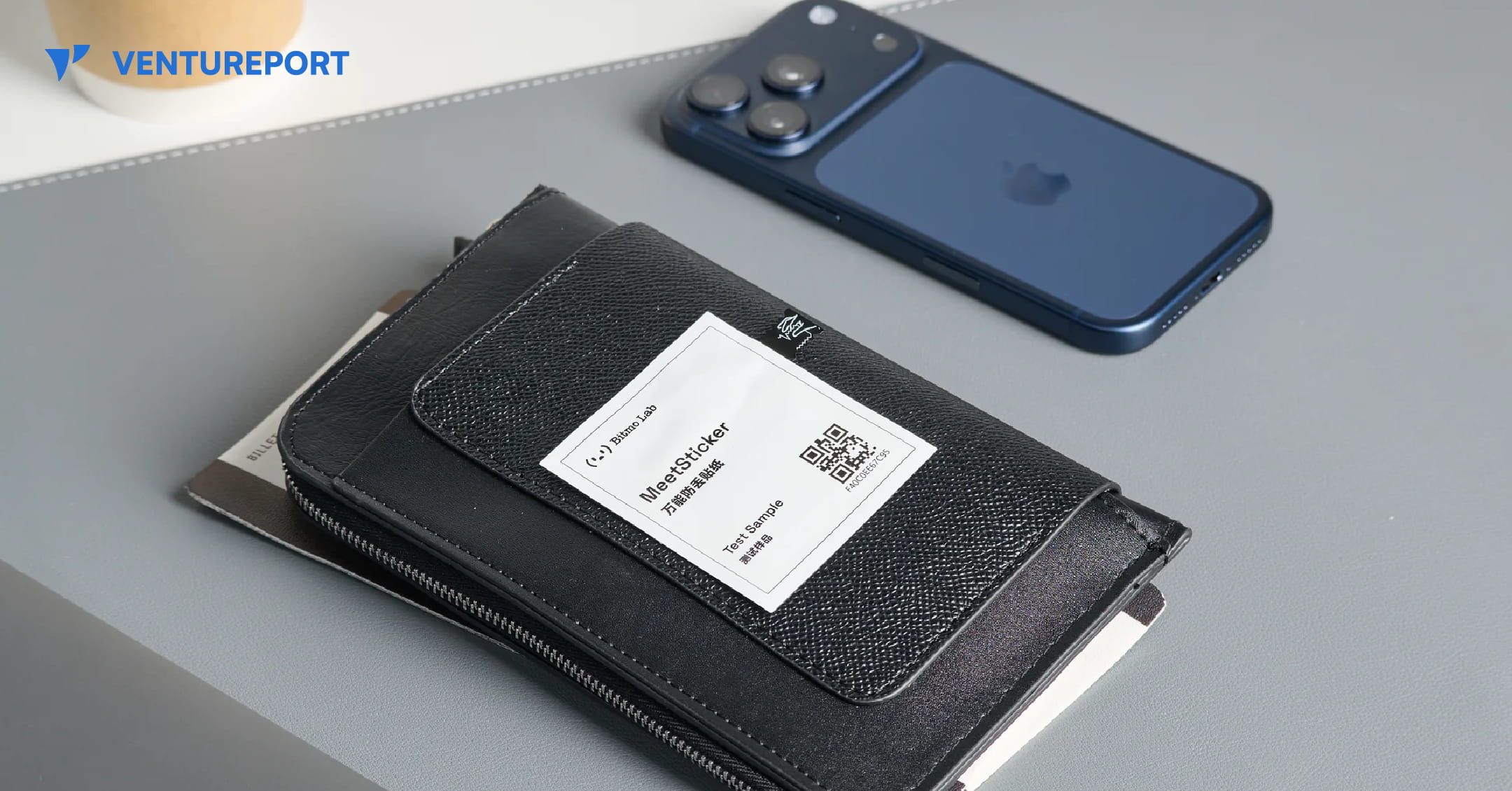
Bitmo Lab's MeetSticker tracker. PHOTO: BITMO LAB
Location trackers have become everyday accessories for keys, bags and luggage. But as personal items grow slimmer and more design-focused — from minimalist wallets to passport sleeves and specialised gear — tracking them has become less straightforward. Most trackers are built as small, rigid discs that assume the presence of space, loops or compartments. That assumption has created a growing mismatch between modern product design and the technology meant to secure it.
Hong Kong–based startup Bitmo Lab is attempting to address that gap with a device called MeetSticker. Instead of the solid plastic casing typical of most trackers, MeetSticker is engineered to be flexible and ultra-thin, measuring just 0.8 millimetres thick. The bendable design allows it to sit within narrow compartments or along curved surfaces without altering the shape of the object. Rather than attaching to an item externally, it is intended to integrate discreetly inside it.
That structural shift is the core of the product’s proposition. By removing the rigid shell that defines conventional tracking hardware, MeetSticker can be placed in items that previously had no practical way to accommodate a tracker. Bitmo Lab states that the device connects through a proprietary network and a companion application compatible with both iOS and Android, positioning it as a cross-platform solution rather than one tied to a single ecosystem.
The implications extend beyond form factor. Objects without obvious attachment points — such as compact travel accessories or specialised tools — could potentially be monitored without visible add-ons. In doing so, the device broadens the scope of tracking technology into categories where aesthetics, aerodynamics or compact design matter as much as functionality.
Before moving toward retail distribution, however, the company is focusing on validation. Bitmo Lab has launched a five-week global alpha testing programme beginning February 9. Sixty participants will receive a prototype unit and early access to the app. According to the company, the programme is designed to assess durability, usability and real-world performance before a wider commercial release. Participants who provide feedback will receive a retail unit upon launch.
Such testing is particularly relevant for flexible electronics. Unlike rigid devices, bendable hardware must withstand repeated flexing, daily handling and environmental exposure. Early user data can help refine manufacturing processes and software optimisation before scaling production.
As with other connected tracking devices, privacy considerations remain part of the equation. Bitmo Lab has stated that data collected during the alpha programme will be used strictly for testing purposes and deleted once the programme concludes.
Whether flexible trackers will redefine the category will depend on how they perform outside controlled testing environments. Still, the introduction of a near-invisible, bendable tracking device reflects a broader shift in consumer technology. As everyday products become thinner and more design-conscious, the tools built to protect them may need to adapt just as seamlessly.
Keep Reading
Reimagining biodefense at the intersection of AI, biology and urgency.
Updated
January 8, 2026 6:34 PM

Through computational tools, Valthos analyzes biological data to design adaptive solutions against emerging threats. PHOTO: VALTHOS
Valthos has raised US$30 million in seed funding, led by the OpenAI Startup Fund, Lux Capital and Founders Fund, to advance its mission of building next-generation biodefense systems.
The company’s work comes at a time when biotechnology is evolving at an unprecedented pace. Biotechnology is moving at record speed. These new tools can lead to life-changing medical discoveries, but they also bring the risk of dangerous biological agents being developed faster than ever.
“The issue at the core of biodefense is asymmetry”, said Kathleen McMahon, co-founder of Valthos. “It’s easier to make a pathogen than a cure. We’re building tools to help experts at the frontlines of biodefense move as fast as the threats they face”. The gap Valthos aims to close is between the rapid rise of biological threats and the slower pace of developing cures. Therefore, the company is developing AI systems that can rapidly analyze biological sequences and significantly shorten the time needed to design medical countermeasures.
“In this new world, the only way forward is to be faster. So we set out to build a new tech stack for biodefense”, said Tess van Stekelenburg, co-founder of Valthos. “This software infrastructure strengthens biodefense today and lays the groundwork for the adaptive, precision therapeutics of tomorrow”.
The company was founded by van Stekelenburg, a partner at Lux Capital and McMahon, the former head of Palantir’s Life Sciences division. Together, they’ve built a multidisciplinary team of experts from Palantir, DeepMind, Stanford’s Arc Institute and MIT’s Broad Institute, bringing together deep experience in software engineering, machine learning and biotechnology.
“Technology is moving fast. An industrial ecosystem of builders, companies and solutions further democratizes AI to provide broad resilience, and ensures the U.S. continues to lead as AI increasingly powers everything around us. As AI and biotech rapidly advance, biodefense is one of the new industry verticals that helps maximize the benefits and minimize the risks”, said Jason Kwon, OpenAI’s Chief Strategy Officer. “Valthos is pushing the frontier of protection and defense in one of the most strategic intersections of multiple world-changing technologies, and with the team to do it”.
Looking ahead, Valthos plans to expand its engineering team and scale its software infrastructure for both government and commercial partners — moving closer to its goal of enabling faster, smarter and more adaptive biodefense capabilities.