
Bitmo Lab is testing an ultra-thin, bendable tracker built to fit inside items traditional trackers can’t
Updated
February 12, 2026 4:43 PM
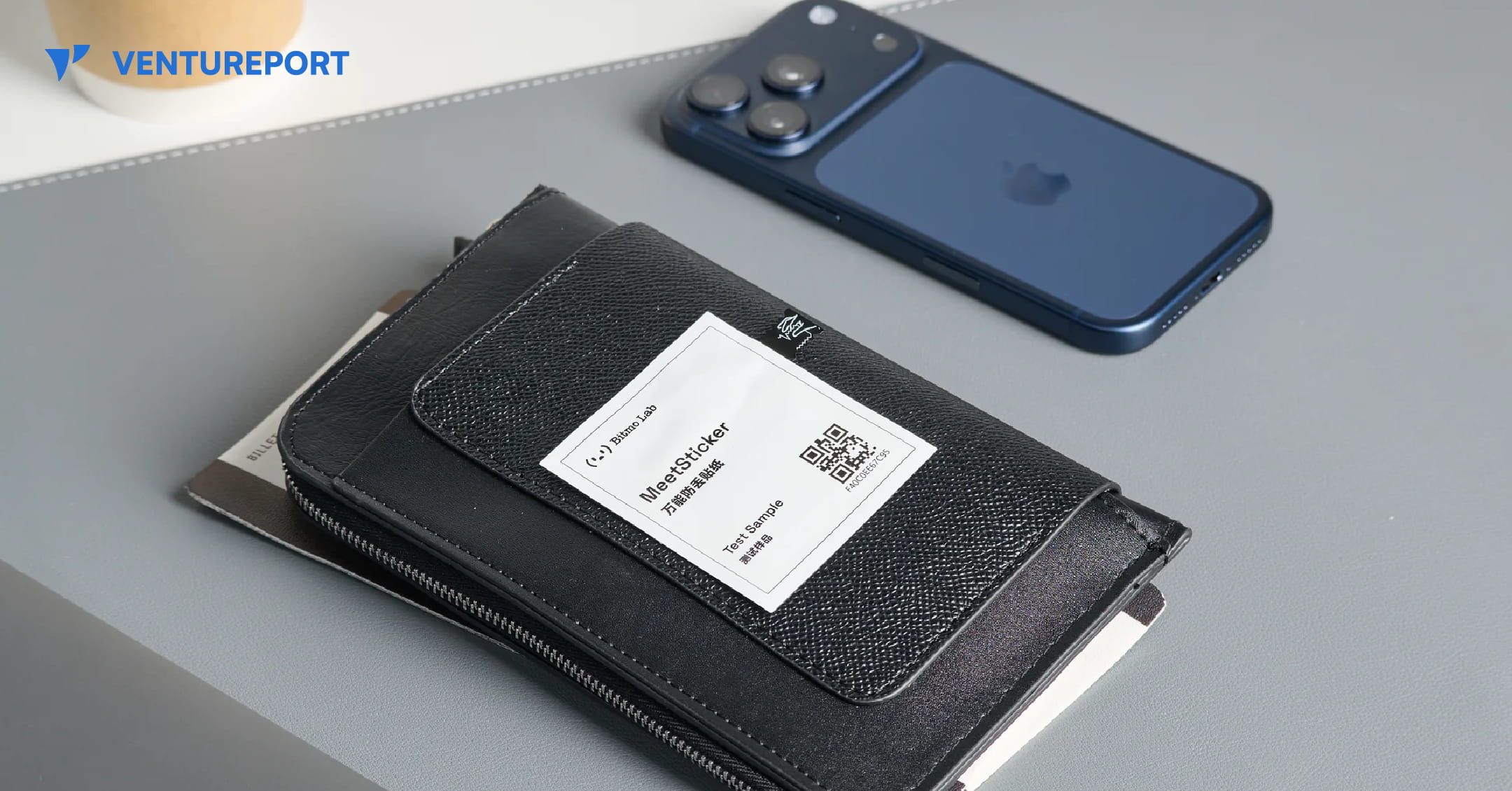
Bitmo Lab's MeetSticker tracker. PHOTO: BITMO LAB
Location trackers have become everyday accessories for keys, bags and luggage. But as personal items grow slimmer and more design-focused — from minimalist wallets to passport sleeves and specialised gear — tracking them has become less straightforward. Most trackers are built as small, rigid discs that assume the presence of space, loops or compartments. That assumption has created a growing mismatch between modern product design and the technology meant to secure it.
Hong Kong–based startup Bitmo Lab is attempting to address that gap with a device called MeetSticker. Instead of the solid plastic casing typical of most trackers, MeetSticker is engineered to be flexible and ultra-thin, measuring just 0.8 millimetres thick. The bendable design allows it to sit within narrow compartments or along curved surfaces without altering the shape of the object. Rather than attaching to an item externally, it is intended to integrate discreetly inside it.
That structural shift is the core of the product’s proposition. By removing the rigid shell that defines conventional tracking hardware, MeetSticker can be placed in items that previously had no practical way to accommodate a tracker. Bitmo Lab states that the device connects through a proprietary network and a companion application compatible with both iOS and Android, positioning it as a cross-platform solution rather than one tied to a single ecosystem.
The implications extend beyond form factor. Objects without obvious attachment points — such as compact travel accessories or specialised tools — could potentially be monitored without visible add-ons. In doing so, the device broadens the scope of tracking technology into categories where aesthetics, aerodynamics or compact design matter as much as functionality.
Before moving toward retail distribution, however, the company is focusing on validation. Bitmo Lab has launched a five-week global alpha testing programme beginning February 9. Sixty participants will receive a prototype unit and early access to the app. According to the company, the programme is designed to assess durability, usability and real-world performance before a wider commercial release. Participants who provide feedback will receive a retail unit upon launch.
Such testing is particularly relevant for flexible electronics. Unlike rigid devices, bendable hardware must withstand repeated flexing, daily handling and environmental exposure. Early user data can help refine manufacturing processes and software optimisation before scaling production.
As with other connected tracking devices, privacy considerations remain part of the equation. Bitmo Lab has stated that data collected during the alpha programme will be used strictly for testing purposes and deleted once the programme concludes.
Whether flexible trackers will redefine the category will depend on how they perform outside controlled testing environments. Still, the introduction of a near-invisible, bendable tracking device reflects a broader shift in consumer technology. As everyday products become thinner and more design-conscious, the tools built to protect them may need to adapt just as seamlessly.
Keep Reading
Can SPhotonix’s optical memory technology protect data better than today’s storage?
Updated
January 8, 2026 6:32 PM

SPhotonix's 5D Memory Crystals™. PHOTO: SPHOTONIX
SPhotonix, a young deep-tech startup, is working on something unexpected for the data storage world: tiny, glass-like crystals that can hold enormous amounts of information for extremely long periods of time. The company works where light and data meet, using photonics—the science of shaping and guiding light—to build optical components and explore a new form of memory called “5D optical storage”.
It’s based on research that began more than twenty years ago, when Professor Peter Kazansky showed that a small crystal could preserve data—from the human genome to the entire Wikipedia—essentially forever.
Their new US$4.5 million pre-seed round, led by Creator Fund and XTX Ventures, is meant to turn that science into real products. And the timing aligns with a growing problem: the world is generating far more digital data than current storage systems can handle. Most of it isn’t needed every day, but it can’t be thrown away either. This long-term, rarely accessed cold data is piling up faster than existing storage infrastructure can manage and maintaining giant warehouses of servers just to keep it all alive is becoming expensive and environmentally unsustainable.
This is the problem SPhotonix is stepping in to solve. They want to store huge amounts of information in a stable format that doesn’t degrade, doesn’t need electricity to preserve data and doesn’t require constant swapping of hardware. Instead of racks of spinning drives, the idea is a durable optical crystal storage system that could last for generations.
The company’s underlying technology—called FemtoEtch™—uses ultrafast lasers to engrave microscopic patterns inside fused silica. These precisely etched structures can function as high-performance optical components for fields like aerospace, microscopy and semiconductor manufacturing. But the same ultra-controlled process can also encode information in five dimensions within the crystal, transforming the material into a compact, long-lasting archive capable of holding massive amounts of information in a very small footprint.
The new funding allows SPhotonix to expand its engineering team, grow its R&D facility in Switzerland and prepare the technology for real-world deployment. Investors say the opportunity is significant: global data generation has more than doubled in recent years and traditional storage systems—drives, disks, tapes—weren’t designed for the scale or longevity modern data demands.
While the company has been gaining attention in research circles (and even made an appearance in the latest Mission Impossible film), its next step is all about practical adoption. If the technology reaches commercial viability, it could offer an alternative to the energy-hungry, short-lived storage hardware that underpins much of today’s digital infrastructure.
As digital information continues to multiply, preserving it safely and sustainably is becoming one of the biggest challenges in modern computing. SPhotonix’s work points toward a future where long-lasting, low-maintenance optical data storage becomes a practical alternative to today’s fragile systems. It offers a more resilient way to preserve knowledge for the decades ahead.