
A new safety layer aims to help robots sense people in real time without slowing production
Updated
February 13, 2026 10:44 AM
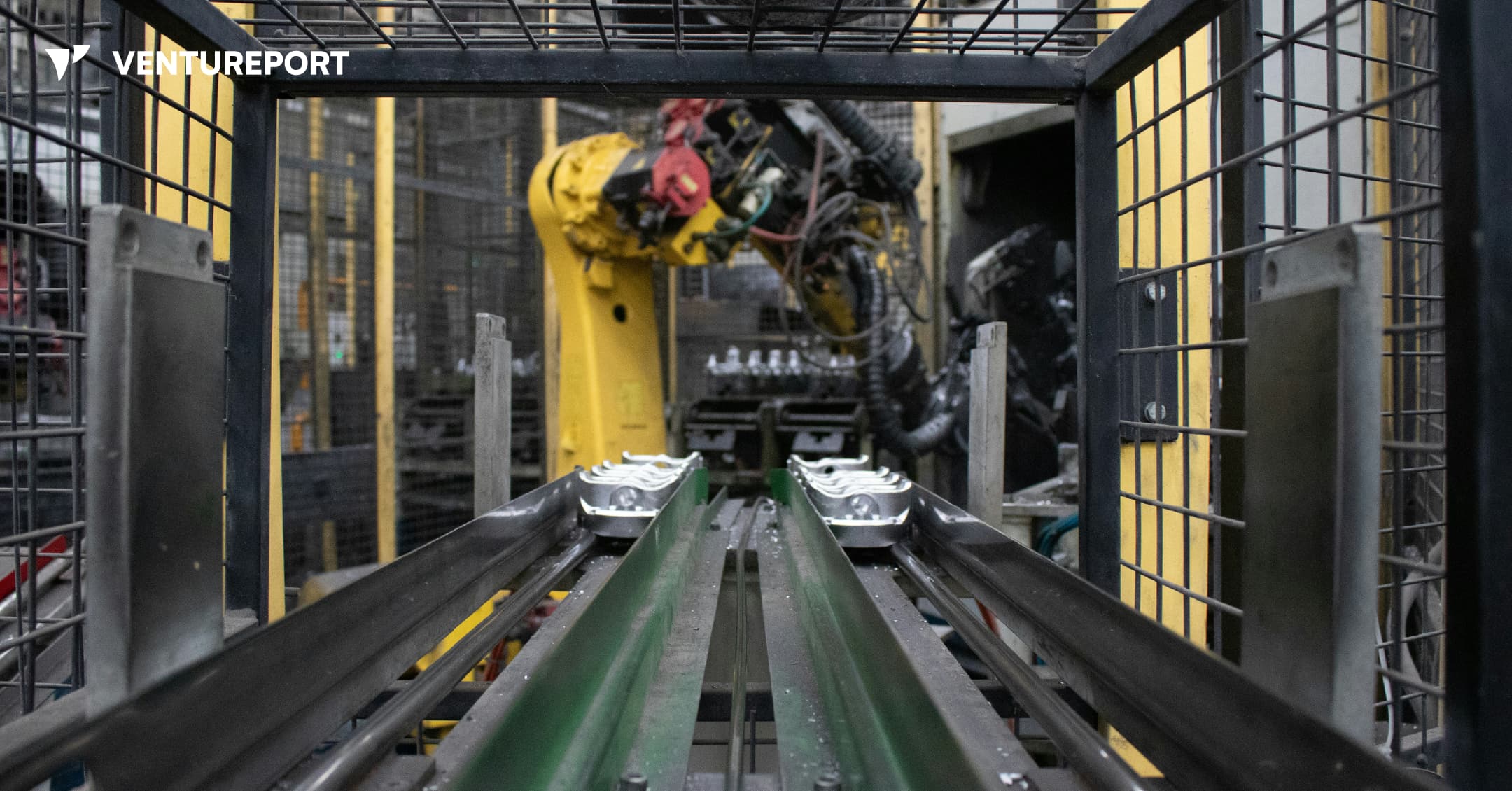
An industrial robot in a factory. PHOTO: UNSPLASH
Algorized has raised US$13 million in a Series A round to advance its AI-powered safety and sensing technology for factories and warehouses. The California- and Switzerland-based robotics startup says the funding will help expand a system designed to transform how robots interact with people. The round was led by Run Ventures, with participation from the Amazon Industrial Innovation Fund and Acrobator Ventures, alongside continued backing from existing investors.
At its core, Algorized is building what it calls an intelligence layer for “physical AI” — industrial robots and autonomous machines that function in real-world settings such as factories and warehouses. While generative AI has transformed software and digital workflows, bringing AI into physical environments presents a different challenge. In these settings, machines must not only complete tasks efficiently but also move safely around human workers.
This is where a clear gap exists. Today, most industrial robots rely on camera-based monitoring systems or predefined safety zones. For instance, when a worker steps into a marked area near a robotic arm, the system is programmed to slow down or stop the machine completely. This approach reduces the risk of accidents. However, it also means production lines can pause frequently, even when there is no immediate danger. In high-speed manufacturing environments, those repeated slowdowns can add up to significant productivity losses.
Algorized’s technology is designed to reduce that trade-off between safety and efficiency. Instead of relying solely on cameras, the company utilizes wireless signals — including Ultra-Wideband (UWB), mmWave, and Wi-Fi — to detect movement and human presence. By analysing small changes in these radio signals, the system can detect motion and breathing patterns in a space. This helps machines determine where people are and how they are moving, even in conditions where cameras may struggle, such as poor lighting, dust or visual obstruction.
Importantly, this data is processed locally at the facility itself — not sent to a remote cloud server for analysis. In practical terms, this means decisions are made on-site, within milliseconds. Reducing this delay, or latency, allows robots to adjust their movements immediately instead of defaulting to a full stop. The aim is to create machines that can respond smoothly and continuously, rather than reacting in a binary stop-or-go manner.
With the new funding, Algorized plans to scale commercial deployments of its platform, known as the Predictive Safety Engine. The company will also invest in refining its intent-recognition models, which are designed to anticipate how humans are likely to move within a workspace. In parallel, it intends to expand its engineering and support teams across Europe and the United States. These efforts build on earlier public demonstrations and ongoing collaborations with manufacturing partners, particularly in the automotive and industrial sectors.
For investors, the appeal goes beyond safety compliance. As factories become more automated, even small improvements in uptime and workflow continuity can translate into meaningful financial gains. Because Algorized’s system works with existing wireless infrastructure, manufacturers may be able to upgrade machine awareness without overhauling their entire hardware setup.
More broadly, the company is addressing a structural limitation in industrial automation. Robotics has advanced rapidly in precision and power, yet human-robot collaboration is still governed by rigid safety systems that prioritise stopping over adapting. By combining wireless sensing with edge-based AI models, Algorized is attempting to give machines a more continuous awareness of their surroundings from the start.
Keep Reading
Can AI companions really help with our mental health?
Updated
January 8, 2026 6:35 PM

A laptop with the text "MENTAL HEALTH" displayed. PHOTO: PEXELS
As technology continues to weave itself into the fabric of our daily lives, it’s starting to play an unexpected role: supporting our mental health. AI companions—digital entities designed to hold natural, empathetic conversations—are emerging as a new frontier in emotional care. Unlike chatbots of the past, these AI companions leverage advanced algorithms and emotional intelligence to provide personalized support, making them more than just tools. They are companions in every sense of the word—always available, always listening, and always ready to offer comfort. But can AI companions truly help us feel better, or are they just another tech trend? Let’s dive into how these digital allies are reshaping mental health care and what their growing presence means for our emotional well-being.
Loneliness is often called an epidemic, with millions of people worldwide feeling isolated or disconnected. While human relationships are irreplaceable, AI companions offer a consistent and accessible alternative to combat feelings of loneliness.
These companions don’t just respond—they engage. They remember your preferences, ask follow-up questions, and adapt their conversations to your needs. Imagine having someone to talk to at any time of day, about anything on your mind, without fear of judgment. AI companions may not replace a human friend, but they can provide a sense of presence and connection that can be profoundly comforting.
In a world where reaching out to others can sometimes feel daunting, AI companions offer a simple solution: they’re always there. This consistency can help people feel less alone, fostering a sense of connection in an increasingly disconnected world.
We all experience moments of stress, sadness, or doubt, and having someone to turn to during those times can make all the difference. AI companions are designed with emotional intelligence, enabling them to recognize and respond to your feelings in real time.
Through sentiment analysis and adaptive learning, these companions can detect when you’re feeling low and tailor their responses to provide comfort. Whether it’s offering words of encouragement, suggesting self-care activities, or simply listening, they provide a safe space to process emotions.
Unlike traditional apps that focus on tracking habits or delivering generic advice, AI companions meet you where you are emotionally. This personalized approach can help users feel truly supported, even in their most challenging moments.
For many of us, expressing our thoughts and emotions openly can feel like a risk. Fear of judgment, misunderstanding, or even burdening others often holds us back. AI companions offer an alternative: a completely private, judgment-free space to share whatever is on your mind.
Talking things out—whether it’s frustrations from the day or deeper personal struggles—can be incredibly therapeutic. And with AI companions, there’s no need to worry about being misunderstood or dismissed. You can let your guard down, explore your feelings, and reflect on your experiences with total freedom.
This safe space for self-expression can be especially valuable for those who struggle to open up to others. It’s not about replacing human relationships but about having an outlet that’s always available and entirely focused on you.
Self-doubt is a common barrier to personal growth, and many of us battle negative self-talk daily. AI companions are programmed to combat this by offering positive reinforcement and encouragement.
For example, if you express doubt about your abilities, an AI companion might respond with affirmations like, “You’ve accomplished so much already—don’t forget how capable you are.” Over time, these small but meaningful interactions can help shift your mindset, replacing self-criticism with self-compassion.
This ability to mirror supportive, affirming conversations can build confidence and foster a more positive self-image. It’s a subtle but powerful way AI companions can contribute to emotional well-being.
AI companions are more than just a tech trend; they represent a new way of thinking about mental health care. By offering companionship, emotional support, safe spaces for self-expression, and tools for mindfulness, they empower users to take control of their well-being.
While they may not replace traditional methods of care, AI companions are making mental health support more accessible, immediate, and personalized. They’re a reminder that sometimes, the smallest interactions—an encouraging word, a moment of mindfulness, or a listening ear—can have the biggest impact.
As we embrace this new era of technology, one thing is clear: AI companions are not just about convenience. They’re about connection, support, and the potential to make emotional care a part of everyday life. And in a world that often feels disconnected, that’s something worth celebrating.