
A new safety layer aims to help robots sense people in real time without slowing production
Updated
February 13, 2026 10:44 AM
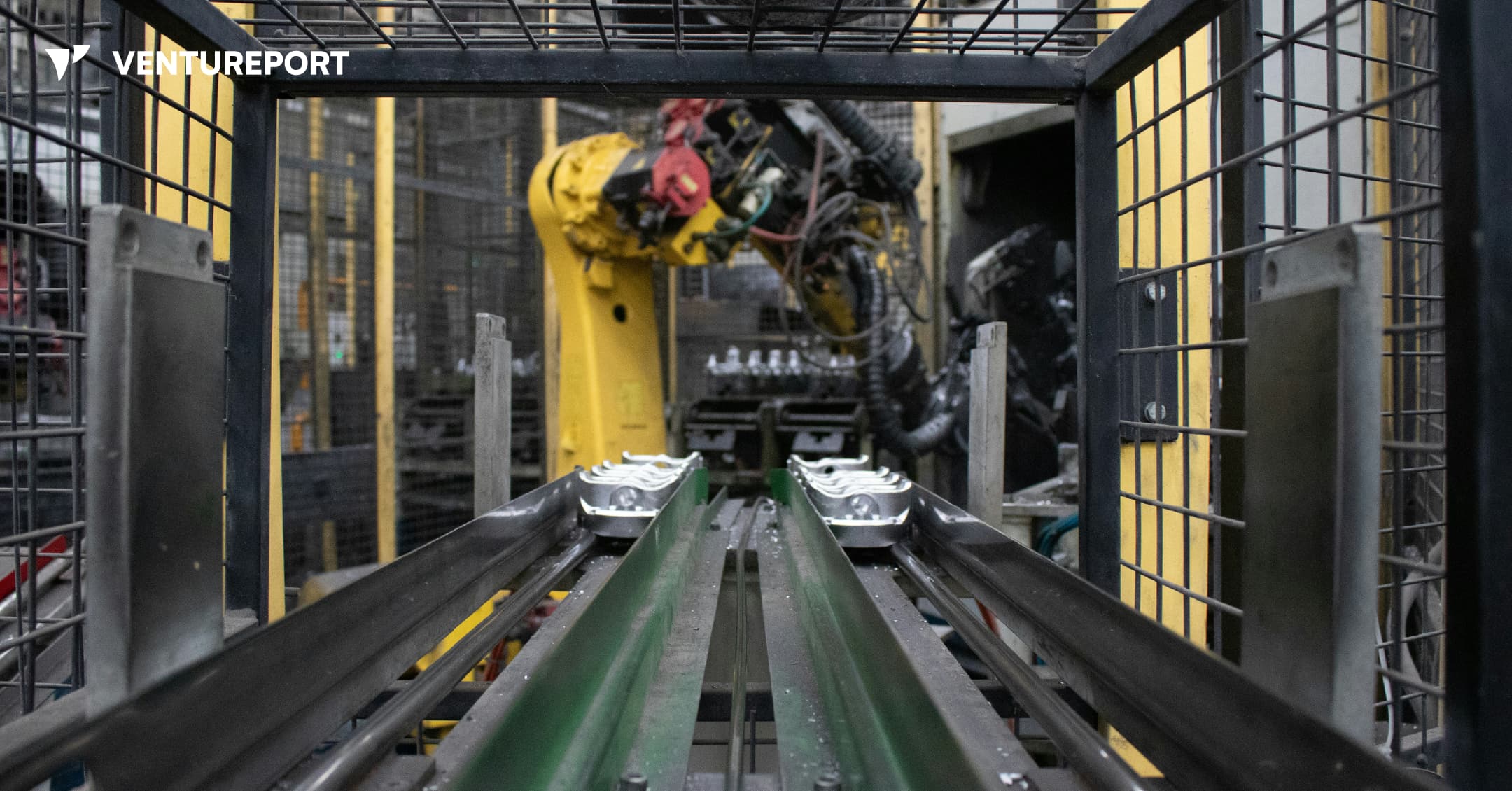
An industrial robot in a factory. PHOTO: UNSPLASH
Algorized has raised US$13 million in a Series A round to advance its AI-powered safety and sensing technology for factories and warehouses. The California- and Switzerland-based robotics startup says the funding will help expand a system designed to transform how robots interact with people. The round was led by Run Ventures, with participation from the Amazon Industrial Innovation Fund and Acrobator Ventures, alongside continued backing from existing investors.
At its core, Algorized is building what it calls an intelligence layer for “physical AI” — industrial robots and autonomous machines that function in real-world settings such as factories and warehouses. While generative AI has transformed software and digital workflows, bringing AI into physical environments presents a different challenge. In these settings, machines must not only complete tasks efficiently but also move safely around human workers.
This is where a clear gap exists. Today, most industrial robots rely on camera-based monitoring systems or predefined safety zones. For instance, when a worker steps into a marked area near a robotic arm, the system is programmed to slow down or stop the machine completely. This approach reduces the risk of accidents. However, it also means production lines can pause frequently, even when there is no immediate danger. In high-speed manufacturing environments, those repeated slowdowns can add up to significant productivity losses.
Algorized’s technology is designed to reduce that trade-off between safety and efficiency. Instead of relying solely on cameras, the company utilizes wireless signals — including Ultra-Wideband (UWB), mmWave, and Wi-Fi — to detect movement and human presence. By analysing small changes in these radio signals, the system can detect motion and breathing patterns in a space. This helps machines determine where people are and how they are moving, even in conditions where cameras may struggle, such as poor lighting, dust or visual obstruction.
Importantly, this data is processed locally at the facility itself — not sent to a remote cloud server for analysis. In practical terms, this means decisions are made on-site, within milliseconds. Reducing this delay, or latency, allows robots to adjust their movements immediately instead of defaulting to a full stop. The aim is to create machines that can respond smoothly and continuously, rather than reacting in a binary stop-or-go manner.
With the new funding, Algorized plans to scale commercial deployments of its platform, known as the Predictive Safety Engine. The company will also invest in refining its intent-recognition models, which are designed to anticipate how humans are likely to move within a workspace. In parallel, it intends to expand its engineering and support teams across Europe and the United States. These efforts build on earlier public demonstrations and ongoing collaborations with manufacturing partners, particularly in the automotive and industrial sectors.
For investors, the appeal goes beyond safety compliance. As factories become more automated, even small improvements in uptime and workflow continuity can translate into meaningful financial gains. Because Algorized’s system works with existing wireless infrastructure, manufacturers may be able to upgrade machine awareness without overhauling their entire hardware setup.
More broadly, the company is addressing a structural limitation in industrial automation. Robotics has advanced rapidly in precision and power, yet human-robot collaboration is still governed by rigid safety systems that prioritise stopping over adapting. By combining wireless sensing with edge-based AI models, Algorized is attempting to give machines a more continuous awareness of their surroundings from the start.
Keep Reading
CES 2026 and the move toward wearable robots you don’t wear all day.
Updated
January 28, 2026 5:53 PM

The π6 exoskeleton from VIGX. PHOTO: VIGX
CES 2026 highlighted how robotics is taking many different forms. VIGX, a wearable robotics company, used the event to introduce the π6, a portable exoskeleton robot designed to be carried and worn only when needed. Unveiled in Las Vegas, the device reflects a broader shift at CES toward robotics that move with people rather than staying fixed in industrial or clinical settings.
Exoskeletons have existed for years, most commonly in controlled environments such as factories, rehabilitation facilities and specialised research settings. In these contexts, they have tended to be large, fixed systems intended for long sessions of supervised use rather than something a person could deploy on their own.
Against that backdrop, the π6 explores a more personal and flexible approach to assistance. Instead of treating an exoskeleton as permanent equipment, it is designed to be something users carry with them and wear only when a task or situation calls for extra support.
The π6 weighs 1.9 kilograms and folds down to a size that fits into a bag. When worn, it sits around the waist and legs, providing mechanical assistance during activities such as walking, climbing or extended movement. Rather than altering how people move, the system adds controlled rotational force at key joints to reduce physical strain over time.
According to the company, the device delivers up to 800 watts of peak power and 16 Nm of rotational force. In practical terms, this means the system is designed to help users sustain effort for longer periods, especially during physically demanding activities_ by easing the body's load rather than pushing it beyond normal limits.
The π6 is designed to support users weighing between 45 kilograms and 120 kilograms and is intended for intermittent use. This reinforces its role as a wearable companion — something taken out when needed and set aside when not — rather than a device meant to be worn continuously.
Another aspect of the system is how it responds to different environments. Using onboard sensors and processing, the exoskeleton can detect changes such as slopes or uneven ground and adjust the level of assistance accordingly. This reduces the need for manual adjustments and helps maintain a consistent walking experience across varied terrain, with software fine-tuning how assistance is applied rather than directing movement itself.
The hardware design follows a similar logic. The power belt contains a detachable battery, allowing users to remove or swap it without handling the entire system. This keeps the wearable components lighter and makes the exoskeleton easier to transport. The battery can also be used as a general power source for small electronic devices, adding a layer of practicality beyond the exoskeleton’s core function.
VIGX frames its work around accessibility rather than industrial automation. “To empower ordinary people,” said founder Bob Yu, explaining why the company chose to focus on exoskeleton robotics. “VIGX is dedicated to expanding the physical limits of humans, enabling deeper outdoor adventures, making running and cycling easier and more enjoyable and allowing people to sustain their outdoor pursuits regardless of age.”
Placed within the wider context of CES, the π6 sits alongside a growing number of portable robots and wearable systems that prioritise convenience, mobility and personal use. By reducing the physical and practical barriers to wearing an exoskeleton, VIGX is testing whether assistive robotics can move beyond niche environments and into everyday life. If that experiment succeeds, wearable robots may become less about dramatic augmentation and more about quiet support — present when needed and easy to put away when not.