
Skip the slogans—real Women’s Day campaigns create impact that lasts
Updated
March 6, 2026 1:23 AM

Mother Armenia monument in Victory Park, Gyumri city, Armenia. PHOTO: ADOBE STOCK
Women’s Day offers brands an opportunity to show what they stand for through meaningful action. But the strongest International Women’s Day campaigns do more than say “thank you”. They speak to women’s everyday lives.
Instead of big, vague empowerment slogans, some brands focus on small moments that shape confidence and wellbeing. Think about how we compliment young girls, how safe public spaces feel, what comfort really looks like and how friendship plays help women grow. When a campaign is built on a real insight and backed by something practical, it lands harder and lasts longer.
If you’re a startup planning a Women’s Day initiative, there’s value in studying what actually works. The examples below show how clarity, credibility and usefulness can turn International Women’s Day into something that feels meaningful and on-brand.

To celebrate the International Day of the Girl on October 11, 2025, Dove launched #ChangeTheCompliment—a campaign that asked parents and caregivers to rethink how they praise girls. Instead of defaulting to looks-based comments, Dove encouraged adults to acknowledge qualities like resilience, intelligence and determination alongside beauty.
The idea was grounded in data from Dove’s 2024 Real State of Beauty report, which found that more than 60% of girls feel pressure to be beautiful. Dove brought the message to life through a digital film showing parents broadening their praise in everyday moments.
In Canada, the campaign expanded through a partnership with psychologist Dr. Vanessa Lapointe, who helped anchor #ChangeTheCompliment in expert insight. She linked the campaign’s core message to Dove’s long-running Self-Esteem Project, launched in 2004 to provide free, evidence-based tools developed with psychologists and body image experts. Some of these tools included “Confident Me”, a classroom workshop on body confidence and “Amazing Me”, age-appropriate lessons designed to support self-esteem at school.
What worked here is that it didn’t stay inside a brand video. Parents, teachers and creators joined in by sharing their own examples online, posting revised compliments, building quick classroom activities or filming short clips where they swapped appearance-based praise for character-based words. From social posts to simple at-home conversations, the idea travelled beyond the original film and made participation easy.
Startup takeaway: Don’t build a Women’s Day campaign around a fuzzy theme. Focus on specific, everyday behaviors your audience relates to and design your campaign to shift them. Specificity makes your message practical and memorable.
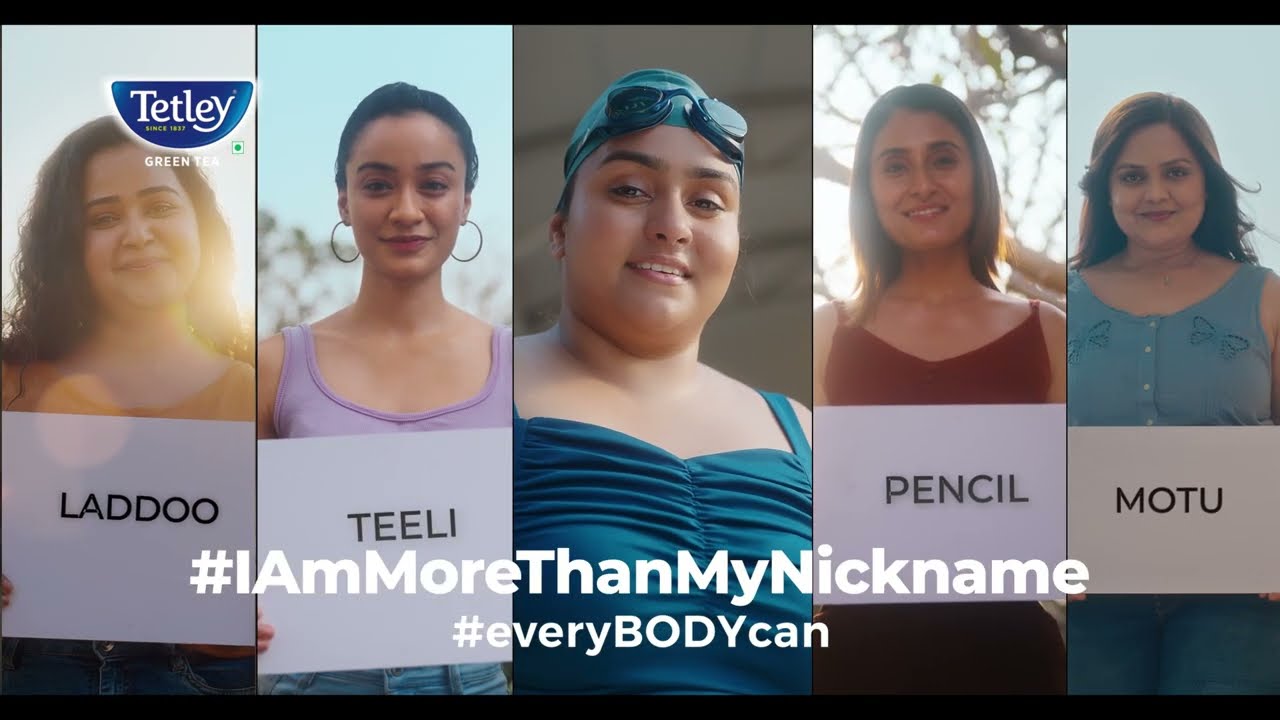
In March 2024, Tetley Green Tea Immune launched the “I Am More Than My Nickname” campaign in India to challenge a common social habit: labeling someone’s fitness based on how their body looks. In many communities, body-type nicknames are used casually. Some of them might sound harmless, but they can chip away at confidence and self-worth over time. Tetley’s point was simple: fitness isn’t a body size. It’s strength, health and well-being.
The campaign centered on a digital film featuring a young girl nicknamed “Golu”, a Hindi term often used to describe someone as chubby. Throughout the film, she’s judged before she even tries, with people deciding what she can and cannot do based on her appearance. As the story unfolds, she pushes back. The film closes with women of different body types holding placards displaying various nicknames, ending with a clear line: “My Body Can, Your Body Can, Every Body Can”. It’s a strong example of a brand taking a familiar social habit and giving people a new way to see it.
Startup takeaway: Look for one small, common behaviour your audience sees every day. Then give people a simple way to engage with it, whether that’s sharing a story, rethinking a phrase or calling out a habit. When participation is baked into the idea, the campaign spreads naturally.

For International Anti-Street Harassment Week 2025, L'Oréal Paris launched its “Never Your Fault” campaign as part of its Stand Up Against Street Harassment program. The campaign drew on L’Oréal Paris research with Ipsos showing the scale of the problem: 75% of women reported experiencing harassment, and 60% said they adjust their clothing or appearance in public.
The message was clear: harassment is never the victim’s fault, and public spaces should feel safer for women. That matters because a lot of women still end up internalizing blame and changing how they dress just to lower the risk.
The campaign also came with a clear next step. It builds on L’Oréal’s partnership with Right To Be, an international NGO focused on stopping harassment, which began in 2020. Through Right To Be’s 5D framework—Distract, Delegate, Document, Delay and Direct—the program teaches bystanders simple, practical ways to intervene safely in the moment.
Startup takeaway: If you’re addressing a sensitive issue in a Women’s Day campaign, don’t go about it alone. Work with experts who bring trust, depth and real tools. It makes your message stronger fast.
.jpg)
In 2025, Van Heusen Innerwear marked Women’s Day with a single visual that many women immediately recognized. The poster showed a crumpled shirt with a bra placed over it, capturing that end-of-day moment of relief.
The slogan on the poster—“Happy Women’s Day has nothing to do with us”—makes the point that real comfort is personal, not performative. The message wasn’t really about taking off a bra, but about the pressure women carry all day, including the expectation to look a certain way, feel a certain way and still keep going. By leaning into a real, everyday experience, Van Heusen positioned itself as a brand that listens rather than lectures.
Startup takeaway: Skip the predictable in Women’s Day slogans. Find an honest, lived moment and build around it. When your campaign reflects real life, it feels relevant instead of seasonal.

In 2025, Mattel celebrated International Women’s Day by honoring real-life female friendship duos with one-of-a-kind Barbie Role Model dolls made in their likeness. The campaign focused on the idea that strong friendships help women grow, succeed and support each other. Instead of spotlighting individual achievement, it highlighted collective strength—women empowering women.
By featuring duos such as Alicia Keys and Ann Mincieli, Jordan Chiles and Jade Carey and other global pairs across sports, entertainment and advocacy, the campaign framed friendship as a source of confidence and ambition from girlhood onward. To make it practical, Mattel partnered with psychologist and best-selling author Dr. Marisa G. Franco, who shared simple advice for girls: take initiative in making friends, assume people will like you, express appreciation openly, try new activities together and prioritize quality over quantity in relationships.
Startup takeaway: If your Women’s Day campaign is built on a social insight, make it actionable. Storytelling helps, but tools, education and frameworks are what make it useful.
Across these International Women’s Day campaigns, the playbook is consistent: choose one real, everyday behaviour and shift it. Whether it’s the way we compliment girls, the labels we use, how bystanders intervene, what comfort feels like or how we nurture friendships, each brand anchored its message in something tangible and built action around it.
For startups, the lesson is straightforward: be precise in what you’re addressing, be credible in how you show up and make your message usable. Attention is easy to grab, but relevance is harder to earn and far more valuable.
Keep Reading
Examining how robots are moving from demonstrations to daily use.
Updated
January 28, 2026 5:53 PM

An industrial robotic arm capable of autonomous welding. PHOTO: ADOBE STOCK
CES 2026 did not frame robotics as a distant future or a technological spectacle. Instead, it highlighted machines designed for the slow, practical work of fitting into human systems. Across the show floor, robots were no longer performing for attention but being shaped by real-world constraints—space, safety, fatigue and repetition.
They appeared in factories, homes, emergency settings and industrial sites, each responding to a specific kind of human limitation. Together, these four robots reveal how robotics is being redefined: not as a replacement for people, but as infrastructure that quietly takes on work humans are least meant to carry alone.
Hyundai Motor unveiled its electric humanoid robot, Atlas, during a media day on January 5, 2026, at the Mandalay Bay Convention Center in Las Vegas as part of CES 2026. Developed with Boston Dynamics, Hyundai’s U.S.-based robotics subsidiary, Atlas was presented in two forms: a research prototype and a commercial model designed for real factory environments.
Shown under the theme “AI Robotics, Beyond the Lab to Life: Partnering Human Progress,” Atlas is designed to work alongside humans rather than replace them. The premise is straightforward—robots take on physically demanding and repetitive tasks such as sorting and assembly, while people focus on work requiring judgment, creativity and decision-making.
Built for industrial use, the commercial version of Atlas is designed to adapt quickly, with Hyundai stating it can learn new tasks within a day. Its adult-sized humanoid form features 56 degrees of freedom, enabling flexible, human-like movement. Tactile sensors in its hands and a 360-degree vision system support spatial awareness and precise operation.
Atlas is also engineered for demanding conditions. It can lift up to 50 kilograms, operate in temperatures ranging from –20°C to 40°C and is waterproof, making it suitable for challenging factory settings.
Looking ahead, Hyundai expects Atlas to begin with parts sorting and sequencing by 2028, move into assembly by 2030 and later take on precision tasks that require sustained physical effort and focus.
Widemount’s Smart Firefighting Robot is designed to operate in environments that are difficult and dangerous for humans to enter. Developed by Widemount Dynamics, a spinout from the Hong Kong Polytechnic University, the robot is built to support emergency teams during fires, particularly in enclosed and smoke-filled spaces.
The robot can move through buildings and industrial facilities even when visibility is near zero. Rather than relying on cameras or GPS, it uses radar-based mapping to understand its surroundings and determine a safe path forward. This allows it to continue operating when smoke, heat or debris would normally restrict access.
As it approaches a fire, the robot analyses the burning object. Its onboard AI helps identify the material involved and selects an appropriate extinguishing method. Sensors simultaneously assess flame intensity and send real-time updates to command centres, giving responders clearer situational awareness.
When actively fighting a fire, the robot can aim directly at the source and deploy extinguishing agents autonomously. The system continuously adjusts its actions based on incoming sensor data, reducing the need for constant human intervention during high-risk situations.
At CES 2026, LG Electronics offered a glimpse into how household work could gradually shift from people to machines. The company introduced LG CLOiD, an AI-powered home robot designed to manage everyday chores by working directly with connected appliances within LG’s ThinQ ecosystem.
Designed for indoor living spaces, CLOiD features a compact upper body with two articulated arms, a head unit and a wheeled base that enables steady movement across floors. Its torso can tilt to adjust height, allowing it to reach items placed low or on kitchen counters. The arms and hands are built for careful handling, enabling the robot to grip common household objects rather than heavy tools. The head also functions as a mobile control unit, housing cameras, sensors, a display and voice interaction capabilities for communication and monitoring.
In practice, CLOiD acts as a task coordinator. It can retrieve items from appliances, operate ovens and washing machines and manage laundry cycles from start to finish, including folding and stacking clothes. By connecting multiple devices through the ThinQ system, the robot turns separate appliances into a single, coordinated workflow.
These capabilities are supported by LG’s Physical AI system. CLOiD uses vision to recognise objects and interpret its surroundings, language processing to understand instructions and action control to execute tasks step by step. Together, these systems allow the robot to follow routines, respond to user input and adjust task execution over time.
Doosan Robotics introduced Scan & Go at CES 2026, an AI-driven robotic system designed to automate large-scale surface repair and inspection. The solution targets environments with complex, irregular surfaces that are difficult to pre-program, such as aircraft structures, wind turbine blades and large industrial installations.
Scan & Go operates by scanning surfaces on site and building an understanding of their shape in real time. Instead of relying on detailed digital models or manual coding, the system plans its movements based on live data. This enables it to adapt to variations in size, curvature and surface condition without extensive setup.
The underlying technology combines 3D sensing with AI-based motion planning. The system interprets surface data, generates tool paths and refines its actions as work progresses. In practical terms, this reduces manual intervention while maintaining consistency across large work areas.
By handling surface preparation and inspection tasks that are time-consuming and physically demanding, Scan & Go is positioned as a support tool for industrial teams operating at scale.
Taken together, these robots signal a clear shift in how machines are being designed and deployed. Across factories, homes, emergency sites and industrial infrastructure, robotics is moving beyond demonstrations and into practical roles that support human work.
The unifying theme is not replacement, but relief—robots taking on tasks that are repetitive, hazardous or physically demanding. CES 2026 suggests that robotics is evolving from spectacle to utility, with a growing focus on systems that adapt to real environments, respond to genuine constraints and integrate into everyday workflows.